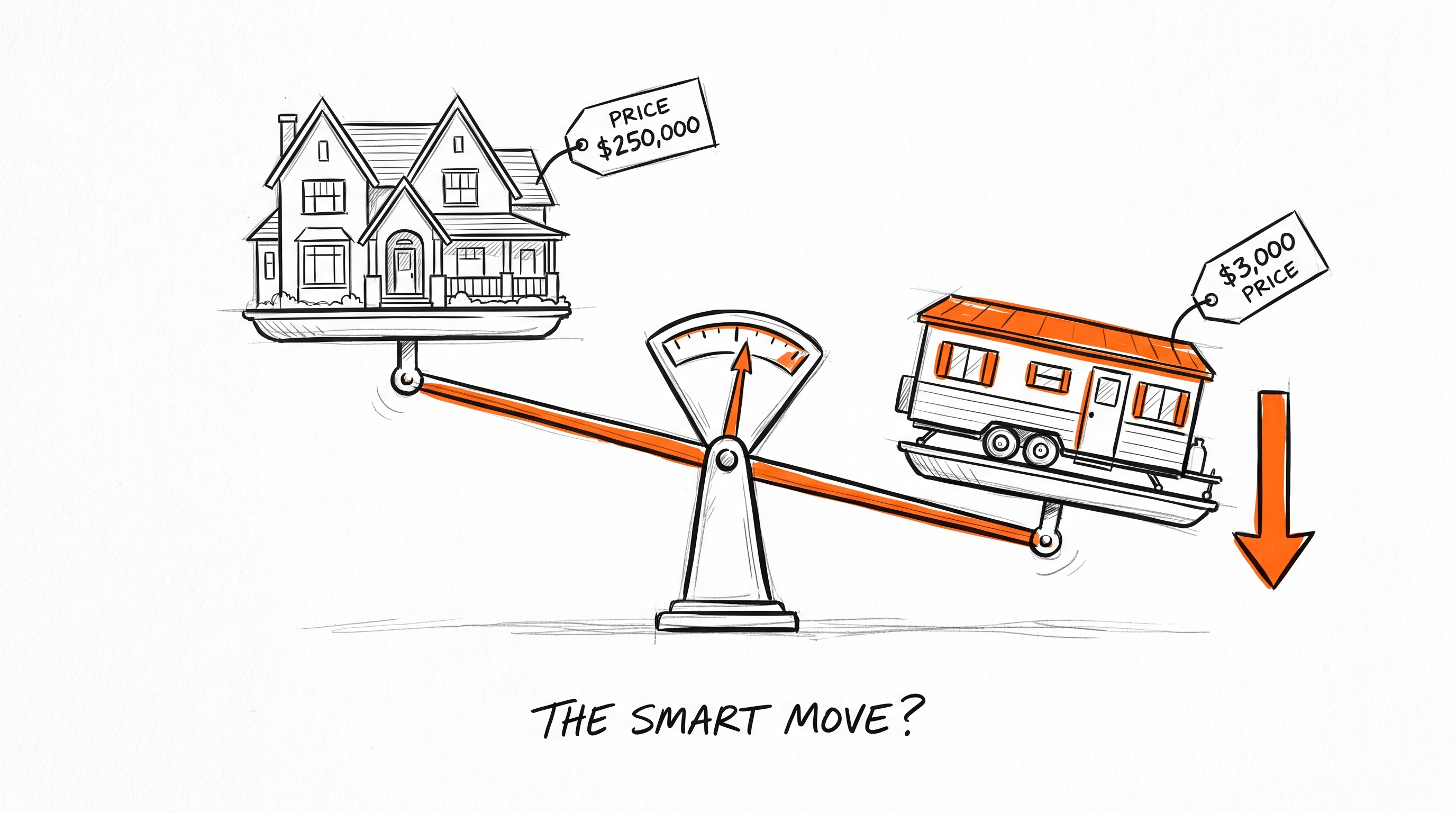
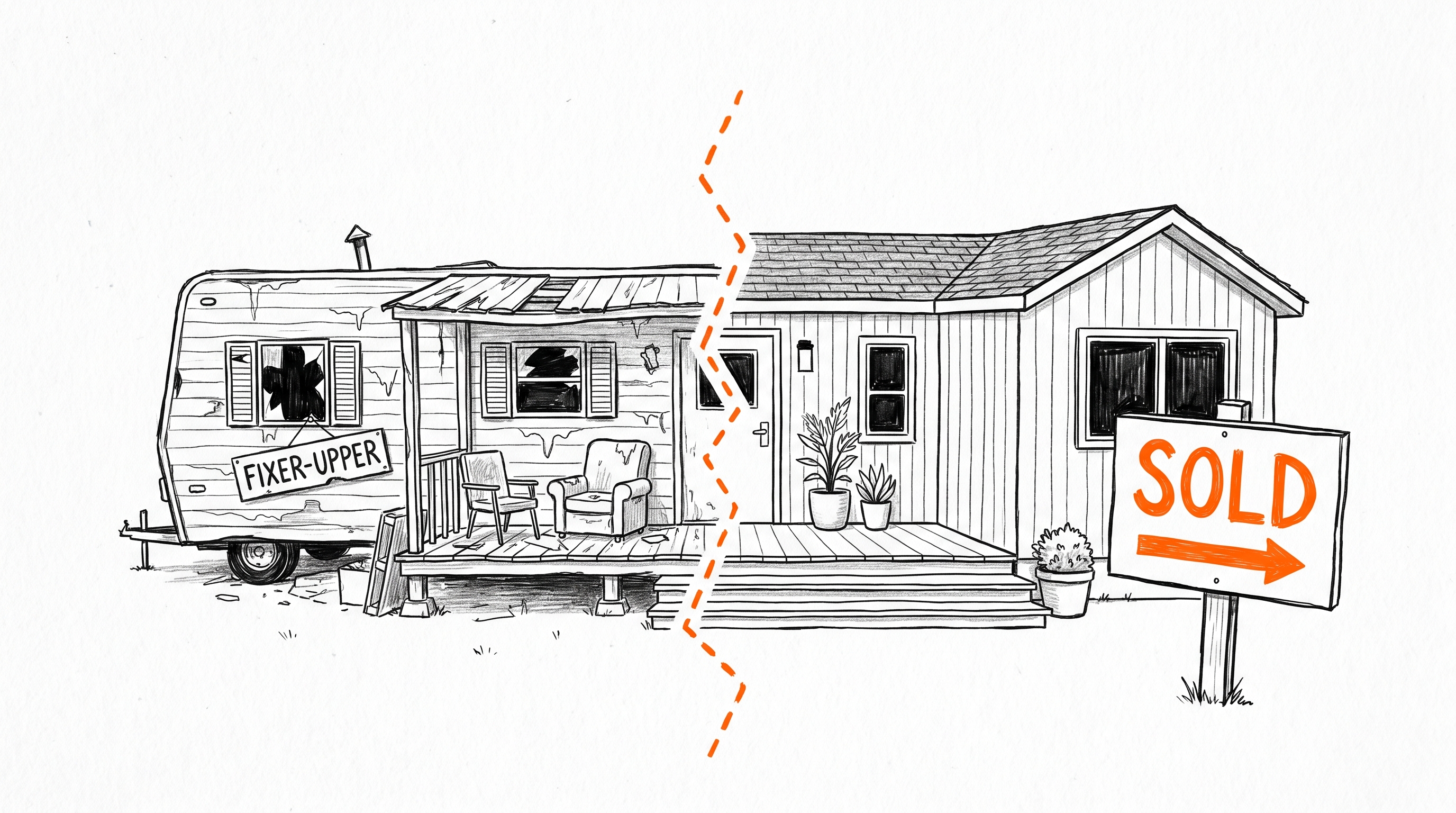
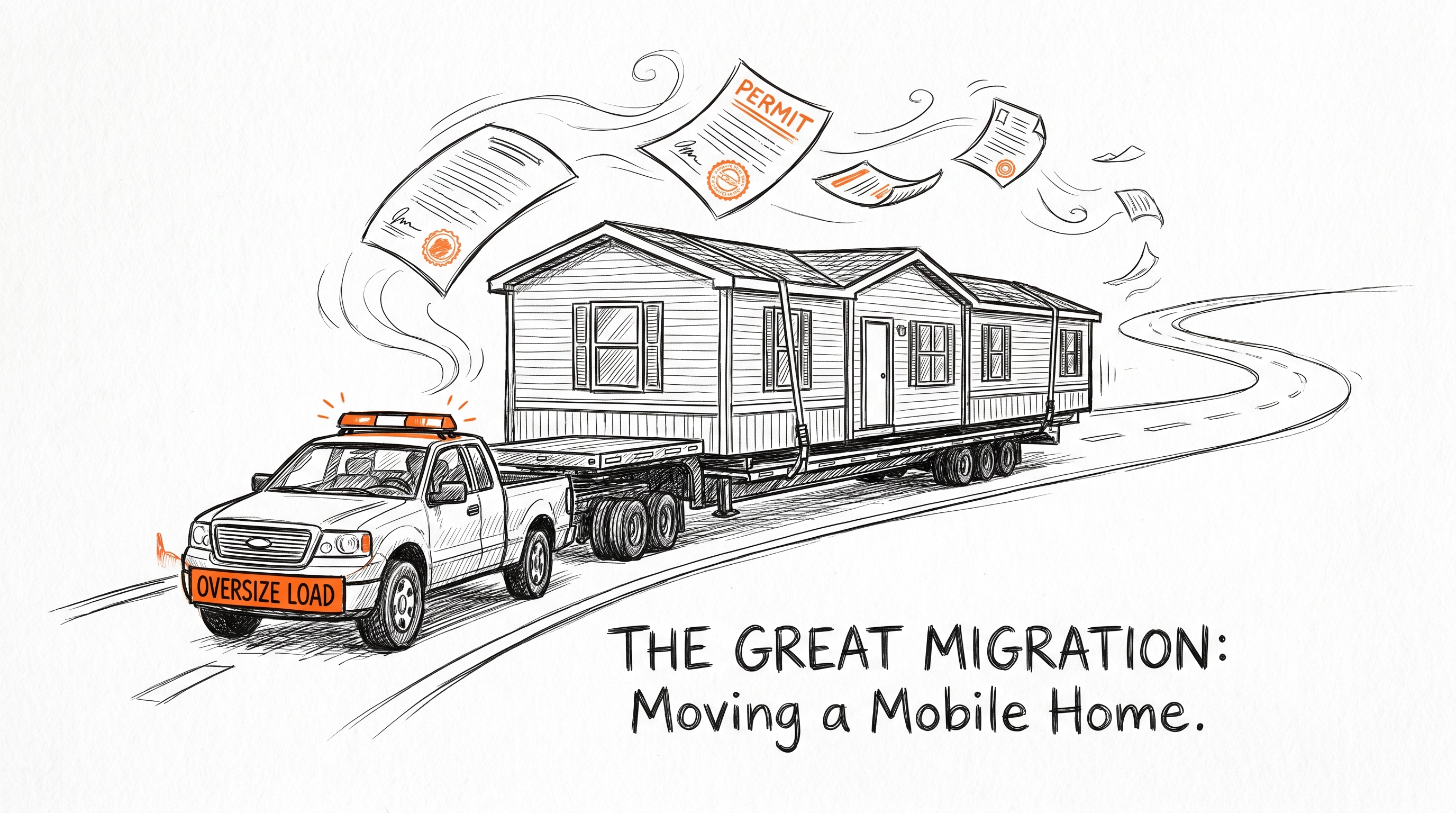
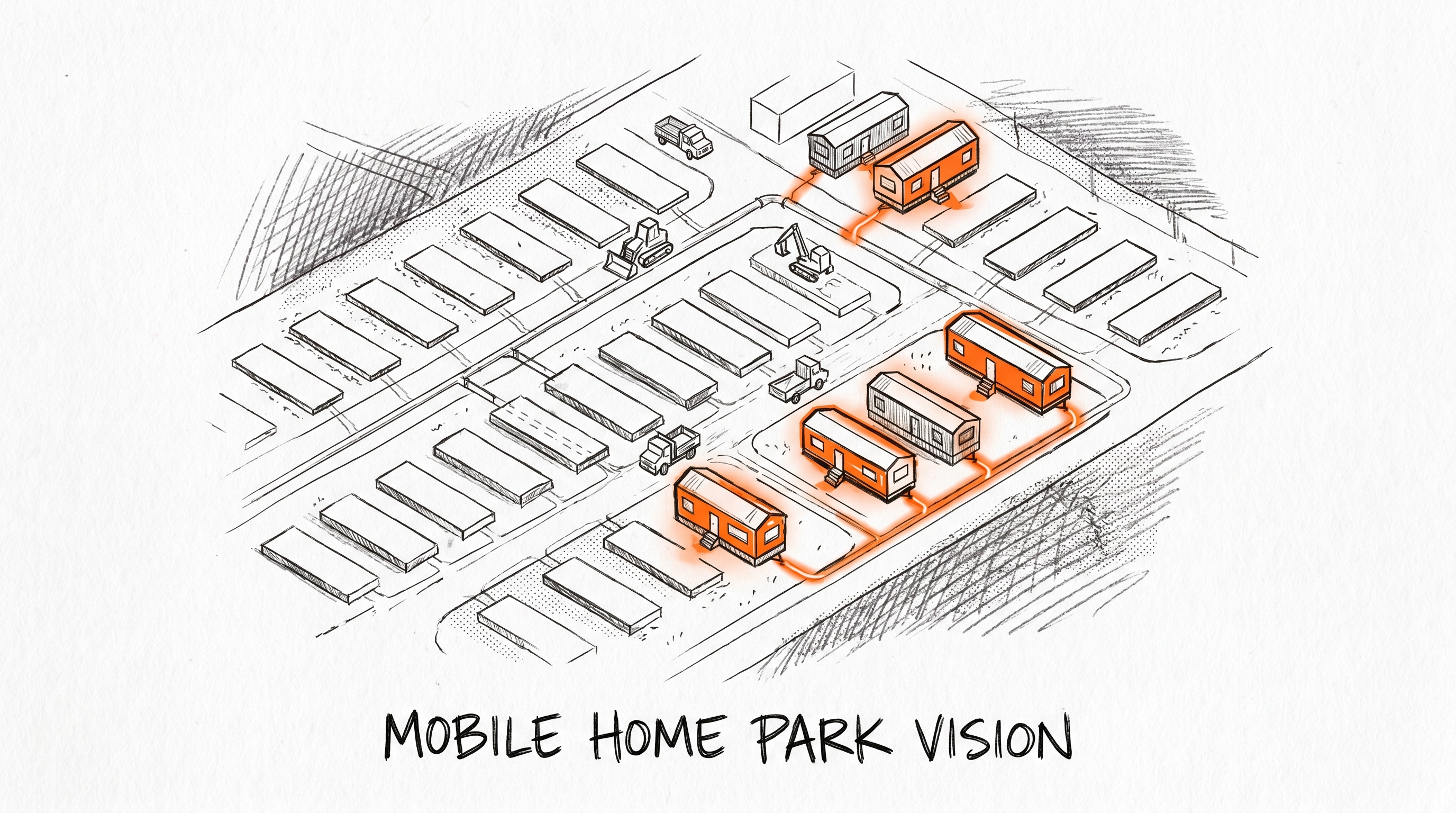
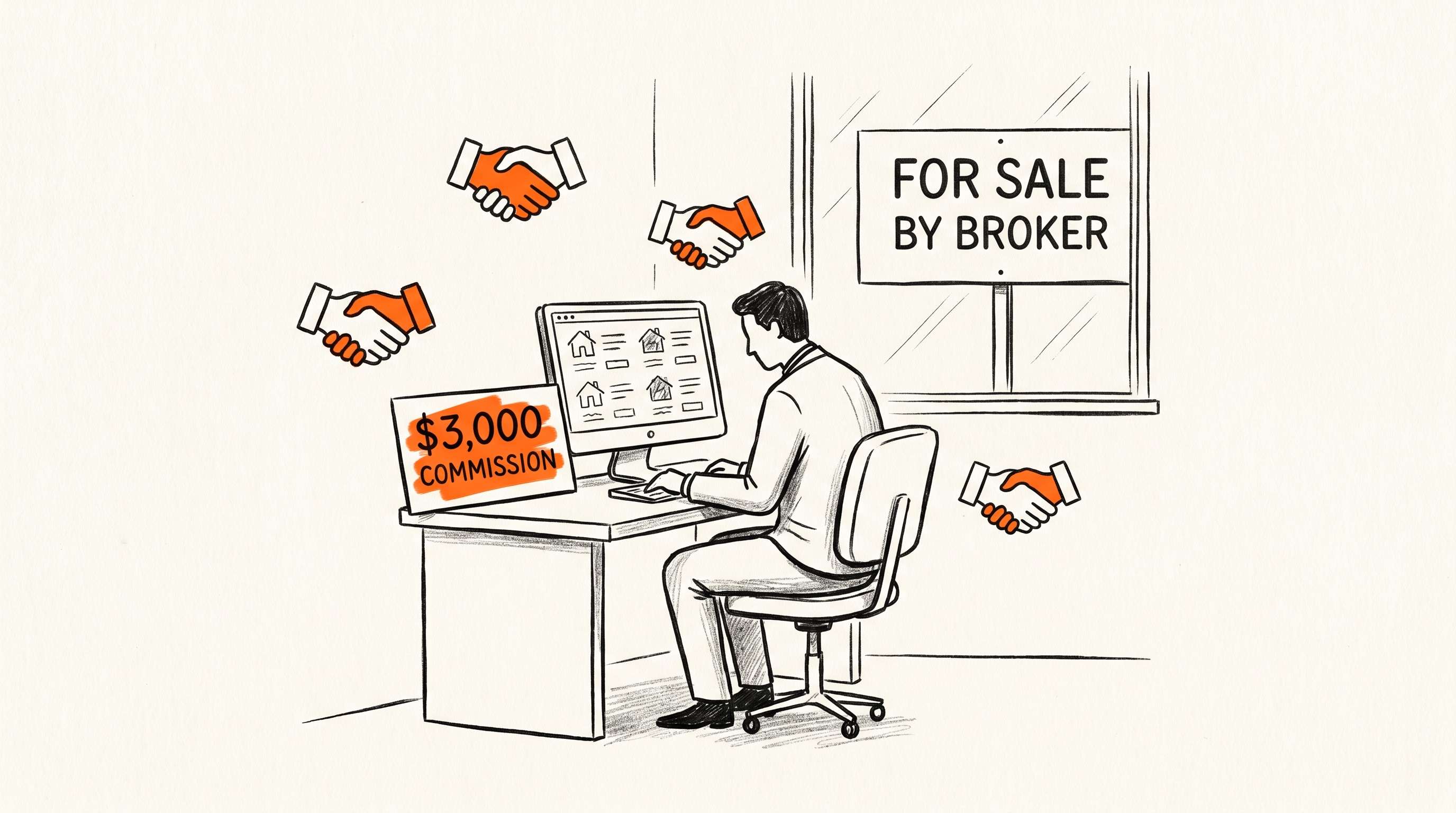
This guide is going to walk you through a lot. History, strategy, stories, tactics, the whole industry. But before we get into any of that, I want to show you the simple, 8-step path to actually doing a deal.
Every step in this guide maps to one of these 8 actions. Some chapters cover one step. Some cover two or three. A few are reference material you'll use across multiple steps. But if you came to this guide asking "what do I actually do?", this page is your answer. Bookmark it. Come back to it when you get lost in the details later.
The 8 Steps
1. Go Find
Find a motivated mobile home seller.
Run targeted ads on Google and Facebook to people searching to sell their mobile home. Build a simple landing page to capture their contact info. Respond to every lead within 5 minutes. Bandit signs, driving for dollars, and park manager relationships also work, but paid ads scale like nothing else. Don't wait for sellers to find you. Hunt for them.
Covered in Chapter 3.
2. Go Estimate
Run the numbers before you ever make an offer.
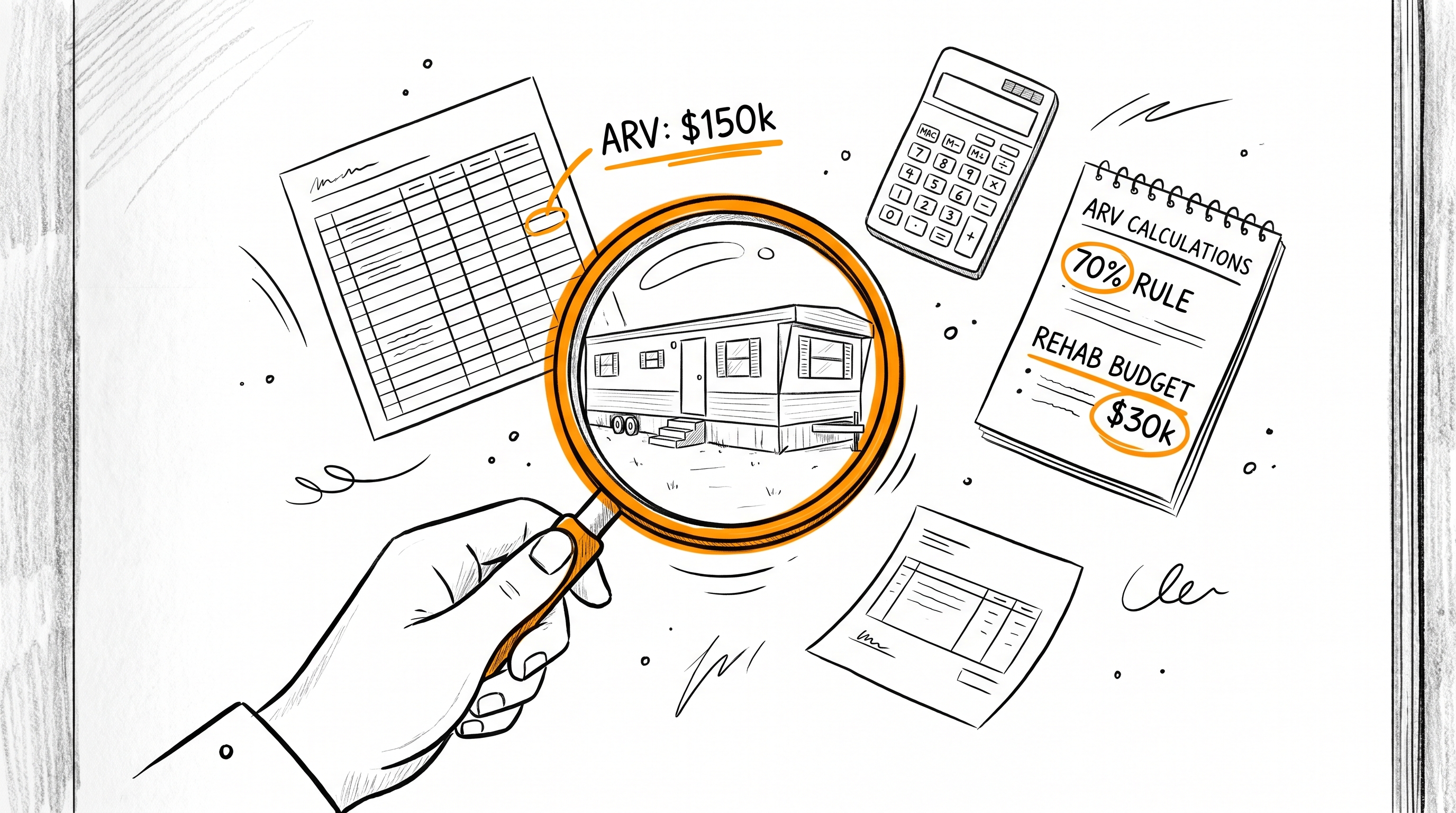
Pull real sold comps (not asking prices) to determine ARV. Estimate rehab costs and add a 20% buffer. Total your holding costs (lot rent x months + utilities + insurance). Apply the 70% rule: Max Purchase Price = ARV × 0.7 minus Rehab minus Holding Costs. Know your walk-away number before you open your mouth.
Covered in Chapter 4.
3. Go Offer
Make the offer. Verbally first. Soft range.
Never offer your max. Never go first on price. Start with a soft range below where you'd actually pay. Ask the seller what they want before you give your number. Use silence when they say something you don't love. You'd be shocked how often sellers accept numbers below what you were willing to pay.
Covered in Chapter 6.
4. Go Negotiate
Close the gap between their number and yours.
Know your walk-away number. Never cross it. Use silence. Get creative with partial-payment or delayed-payment offers when a seller needs cash today but the numbers are tight. Walk away politely if the math doesn't work. Many walked-away sellers call back.
Covered in Chapter 6.
5. Go Acquire
Get the title in your name.
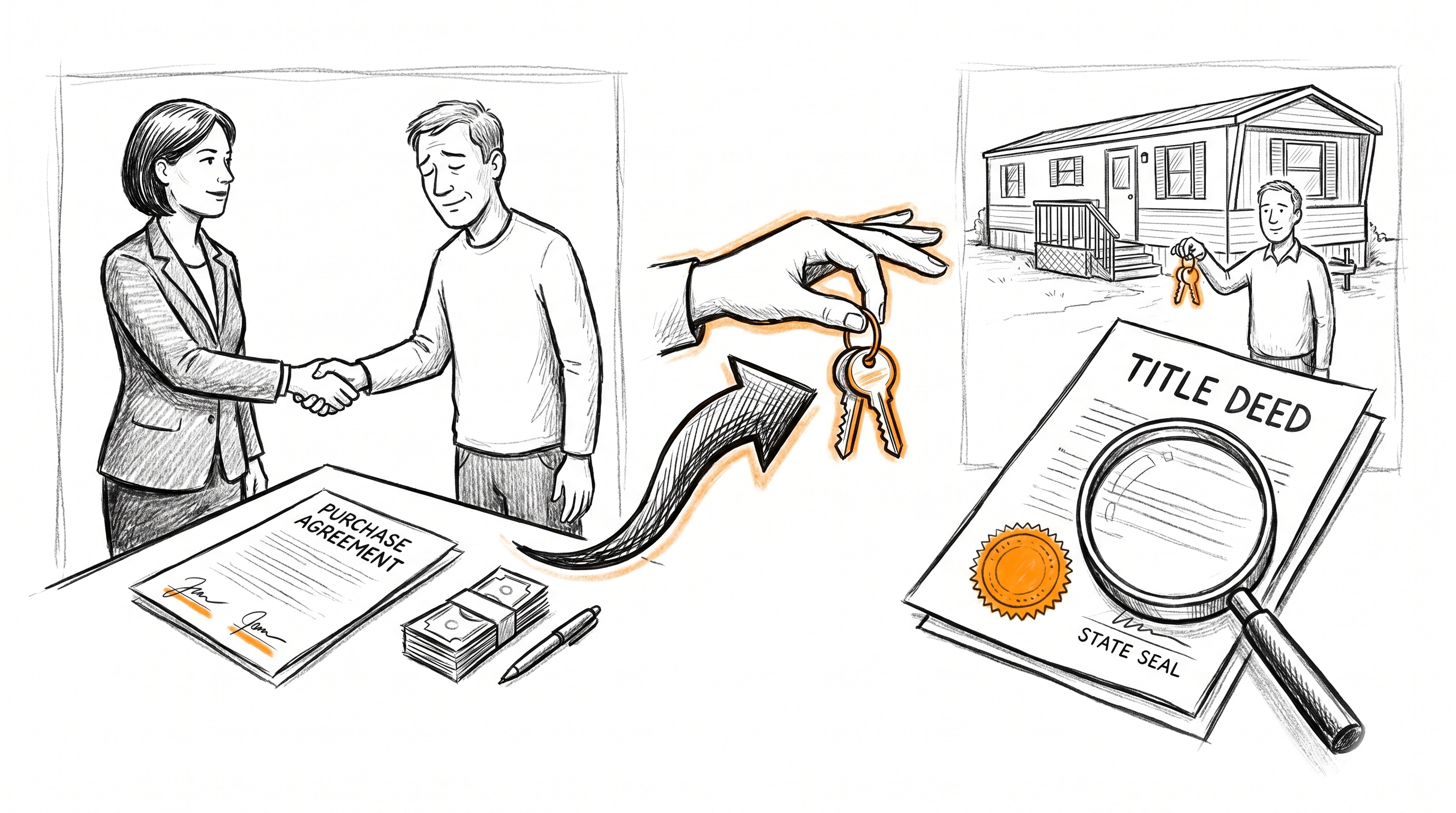
Write a purchase agreement (AI draft + attorney review works well for your first few). Earnest money deposit tied to dates. Inspection contingency period. Get a copy of the seller's ID. Title search through TDHCA (Texas) or your state's DMV/housing agency. Lien check. Electronic signatures when possible. Close the deal. File title transfer. Document everything.
Covered in Chapter 6.
6. Go Dispo
Decide how you're going to exit the deal before you close on it.
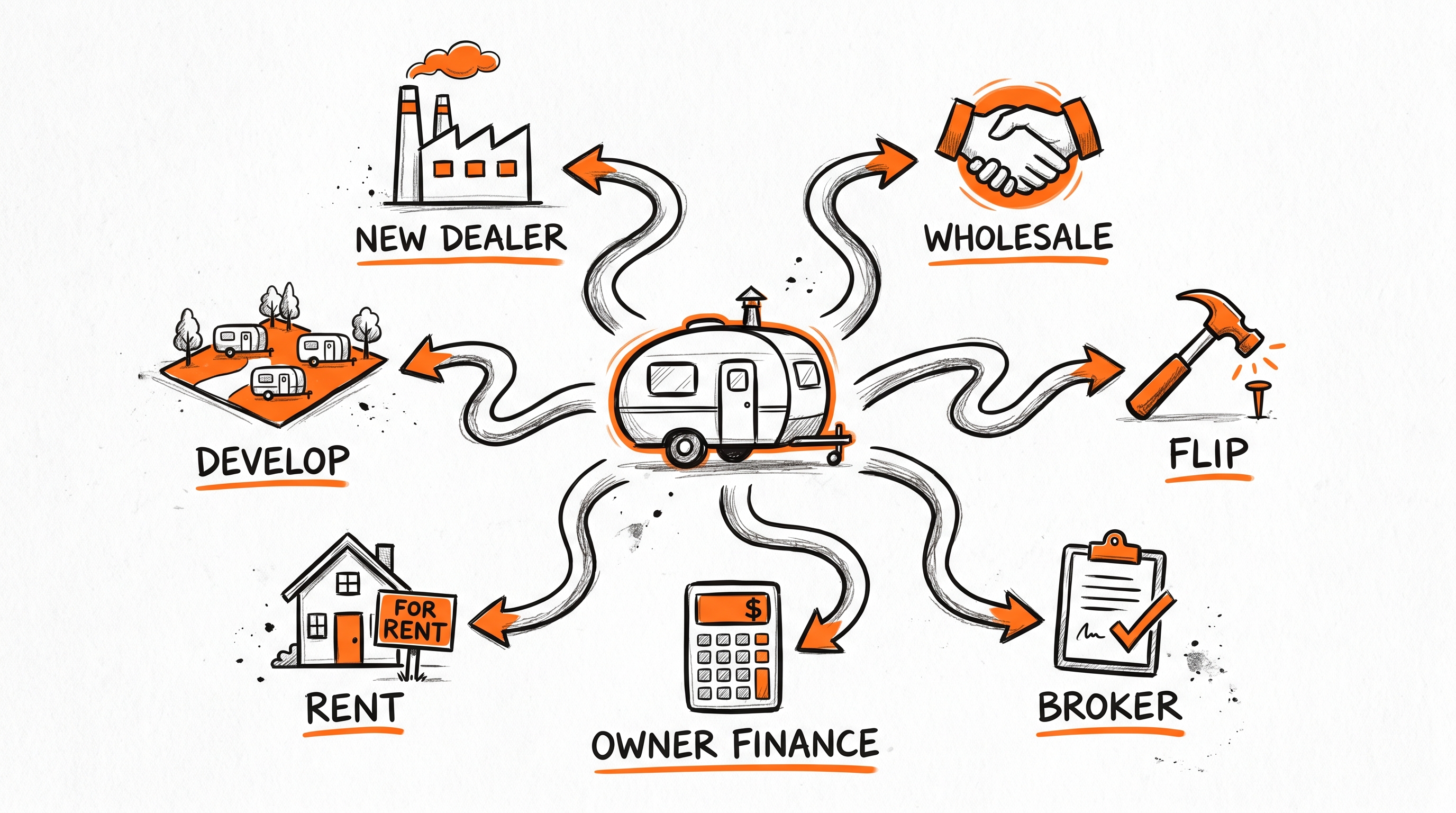
"Dispo" is short for disposition, which is just a fancy real estate term for "selling." Mobile homes have seven different disposition strategies: wholesale, fix-and-flip, broker as a listing agent, owner financing, rent it out, move it to a better location, or develop land around it. Match the strategy to the specific deal. The best exit depends on the home, the park, the market, and your capital.
Covered in Chapters 2 and 7.
7. Go Sell
Execute the sale and collect the check.
Rehab to budget (what buyers touch and see: paint, flooring, kitchen, bath). List on Facebook Marketplace + MHVillage. Respond to inquiries fast. Take a deposit to lock serious buyers. Write a purchase agreement with inspection and financing contingencies. Close through a title company (real property) or direct state transfer (personal property). Deposit the check.
Covered in Chapter 7.
8. Go Scale
Turn one deal into a business.
One deal is a project. Ten deals is a business. You can't do ten deals at once by hand. You need systems. Go Grow = paid ads running every day generating leads automatically. Go Close = AI responding to every lead within 60 seconds, 24/7, qualifying, booking, and following up. Together they become Go Scale, a self-running pipeline that keeps feeding you deals without your hands on every step.
Covered in Chapter 11.
One More Thing
Don't try to do all 8 steps on day one. Today, you only need to focus on Go Find. Get your ad running. Get your first lead. Everything else happens in sequence as the deal unfolds. This guide walks you through each step in detail, with real stories and the specific tactics I've used across 100+ deals.
Now let's go.
You are hereChapter 01: The Opportunity
1
Go Find
2
Go Estimate
3
Go Offer
4
Go Negotiate
5
Go Acquire
6
Go Dispo
7
Go Sell
8
Go Scale
Chapter 01
The Opportunity
My name is Ivan Mills. I've generated millions worth in manufactured home leads, helped hundreds of clients buy and sell manufactured homes, and now help mobile home investors nationwide scale their businesses by outsourcing and automating the repeatable parts so they can focus on closing more deals and doing what they love. I'm passionate about helping people and transforming the mobile home industry. I want to help sellers and investors, real people, make good decisions and grow their businesses while pushing back on greedy park owners who seek to take advantage of people living and owning homes in communities.
This guide is the playbook I wish someone had handed me on day one. But before I tell you what's in it, let me show you something.
Two Deals. You Pick.
Below are two real estate flips. Same investor. Same work ethic. Look at the numbers and tell me which one you'd rather do.
Both deals are profitable. On the surface, Deal A looks like the clear winner. It makes $33,650 compared to $15,900. Twice the profit. Case closed, right?
Not so fast.
Deal A requires $75,000+ in upfront cash and a hard money loan to pull off. Deal B requires $9,100 total. Deal A ties up your capital for six months. Deal B is done in two. Deal A returns 45% on your investment. Deal B returns 175%.
Now here's where it gets interesting. With the $75,000 you'd need for Deal A, you could fund eight Deal B's running at the same time. Eight flips at $15,900 profit each is $127,200. That's nearly four times the profit of Deal A, with each individual deal carrying a fraction of the risk.
Deal A is a single-family house flip. Deal B is a mobile home.
And keep in mind, Deal A went perfectly. No surprises. No contractor disasters. No market dip. Now imagine the market drops 10% during your six-month rehab. That $33,650 profit evaporates into a loss. Deal B, with only $9,100 at stake, absorbs that hit and still keeps you in the black.
Why Most Investors Miss This
Most real estate investors won't touch mobile homes. And there are two reasons for that, both of which are wrong.
The first? They assume that because the price is low, the profits must be low too. You've just seen the numbers. A $9,100 mobile home investment returned 175%. A traditional house flip requiring $75,000+ in cash returned 45%. The mobile home made less total dollars on a single deal, sure. But your money worked nearly four times harder. And if you run multiple deals with the same capital? The total profit isn't even close.
The second reason is that mobile homes feel confusing. And honestly? They are more complicated than traditional real estate. You're dealing with parks, community rules, titling issues you handle yourself, lot rent, and a regulatory world most realtors have never touched. I get it. When I started, I didn't understand half of this either.
But that confusion is a moat. And the numbers prove it.
There are 1.5 million licensed real estate agents in America right now. They're all fighting over about 1.3 million home listings. More agents than homes for sale. Read that again. More people trying to sell houses than there are houses to sell.
Now look at manufactured homes. Roughly 2,400 licensed dealers serving over 7.2 million homes. That's one dealer for every 2,953 homes.
You can either join a crowd of 1.5 million people all chasing the same deals, or you can learn a market where almost nobody is competing. The complexity isn't a wall. It's a filter. And everyone who says "too complicated" is clearing the field for you.
This guide exists to get you through that filter. By the time you're done reading, you'll understand every piece of the puzzle, and you'll wonder why more people aren't doing this.
The Forgiveness Factor
Let me share a quick story about my first mobile home investment. By all intents and purposes, it was a complete and utter failure. And I still made a profit.
I bought a home in College Station, Texas for about $14,000. It needed to be moved to a new park. I overpaid for the home. Got overcharged on the move. Arrived at the new park and didn't have the right permits, so I had to hire expensive contractors from the park's approved vendor list and overpaid on every piece of construction. I hired bad contractors who botched the steps and skirting, so I paid to have that work done twice. I underestimated what the home would sell for. And I held it for nine months paying $550 a month in lot rent while all of this played out.
Total cost: $42,175. Sale price: $45,000. Profit: $2,639.
Not exactly a highlight reel. But here's why I'm telling you this.
Had this been a traditional home flip with this many problems, I would have likely lost $50,000 or more. The interest payments on a hard money loan alone would have buried me. But because my total investment was $42,000 instead of $250,000+, I had room to make every mistake in the book and still walk away with money in my pocket. That is what I call the forgiveness factor. The low buy-in gives you a buffer that traditional real estate simply cannot match. You can screw up badly and still survive. Try doing that with a house flip where you owe a lender $175,000 at 12% interest. You don't get nine months of mistakes. You get a foreclosure.
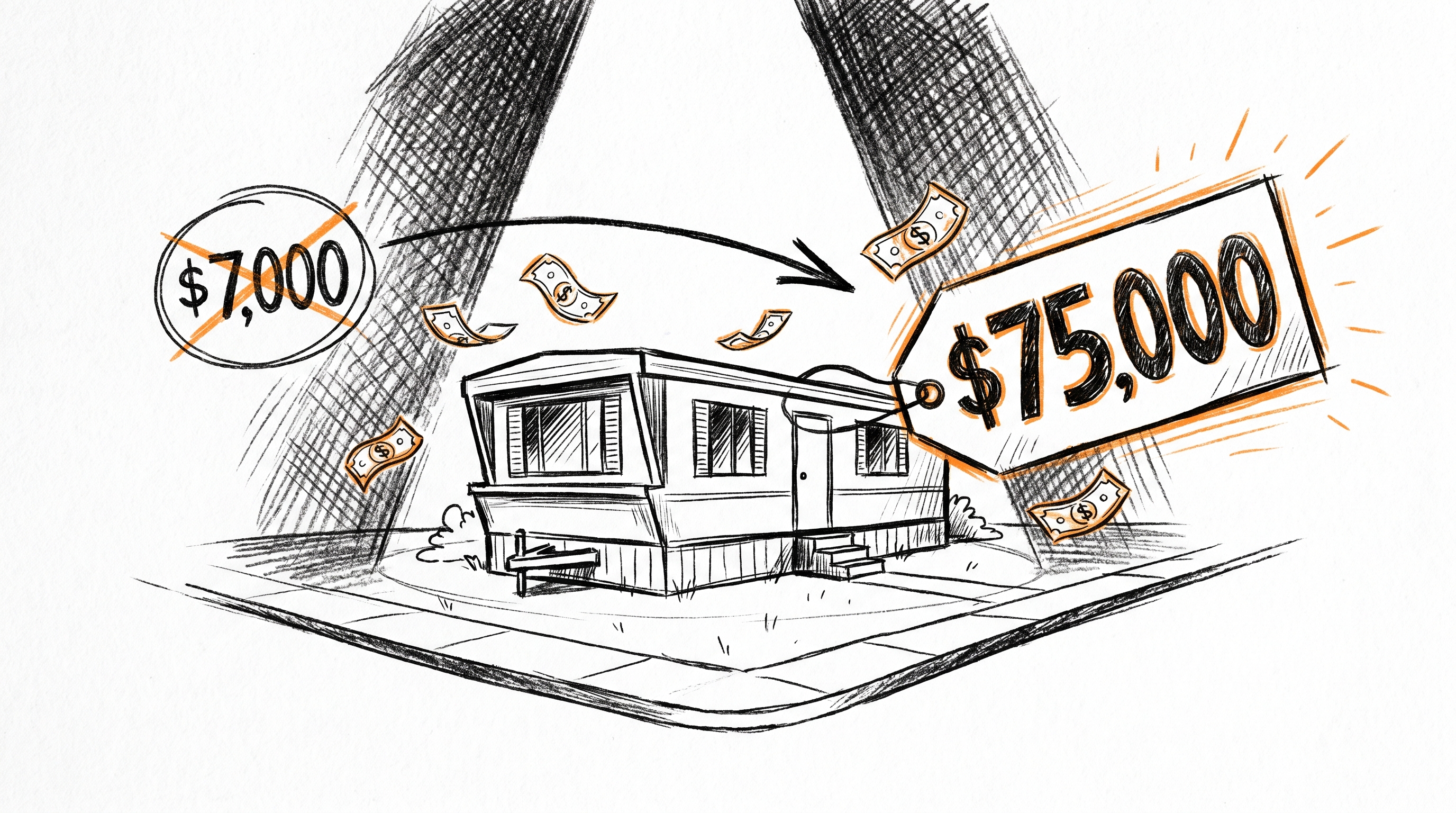
And that same year? I found a large doublewide for $7,000, put about $20,000 into rehab, and sold it for $75,000. That's $48,000 in profit on a single deal. Same investor. Same year. The difference was I had learned from every mistake on that first disaster. The one deal taught me everything I needed to make the other one a home run.
Now imagine running two, three, or five deals like that at the same time.
What This Guide Will Give You
I'm going to be honest with you. Most people who read this guide won't do anything with it. They'll think it's interesting, maybe tell a friend about it, and go back to whatever they were doing before. But if you're the kind of person who takes action, what follows is everything you need to start investing in mobile homes.
Here's what we'll cover:
The seven ways to make money with mobile homes and which one to start with
How to find deals that other investors miss
How to evaluate a deal so you never overpay
The park problem, and the Hard Park Playbook for working in tough communities
From offer to keys: negotiating and acquiring a deal
How to rehab and sell for maximum profit
How to move a mobile home and avoid the disasters I didn't
Development, new homes, and land packages
How to broker deals and scale without swinging a hammer
How to scale any business model with AI and automation
Joining the movement to transform this industry
Let's get into it.
You are hereChapter 02: The 7 Ways to Make Money
1
Go Find
2
Go Estimate
3
Go Offer
4
Go Negotiate
5
Go Acquire
6
Go Dispo
7
Go Sell
8
Go Scale
Chapter 02
The 7 Ways to Make Money
One of the biggest mistakes new investors make is thinking there's only one way to profit from mobile homes. They picture buying a beat-up singlewide, slapping some paint on it, and flipping it. That's one path. It's a good one. But it's only one of seven.
Understanding all seven matters because each one fits a different personality, risk tolerance, and lifestyle. Some require zero capital. Some build generational wealth. Some let you scale to 100 deals at once without ever picking up a hammer. The investors who make the most money aren't locked into one lane. They know when to wholesale, when to flip, and when to broker.
Here's the other thing nobody tells you: you don't have to pick just one. Most successful investors I know use two or three of these models depending on the deal. The key is knowing what each one looks like so you can match the right strategy to the right opportunity when it shows up.
This section walks through each model with real numbers so you can figure out which one fits you.
1. Wholesaling ($0 Down, Best for Beginners)
If you have no money to invest, start here.
Wholesaling means getting a home under contract at a deep discount, then selling that contract to an end buyer. That end buyer is typically another investor or someone looking for a fixer-upper at a bargain. The price you negotiate with the seller is so low that you can add $10,000 onto it and still offer a great deal to the buyer. You did the hard work of finding the home, talking to the seller, and locking it up. The assignment fee is your profit.
The risk is real though. If you can't find an end buyer, you either buy the home yourself or go back to the seller and break your contract. Nobody wants to be in that position. So here's my rule: only wholesale in hot markets where you're confident the deal will move, or be willing to take the deal down yourself if it doesn't.
One more thing, and I feel strongly about this. Be extremely honest with sellers upfront. Don't mislead them. Don't overpromise. If you aren't planning to buy the home yourself, tell them that. This industry has enough dishonest people. Don't be one of them. The investors who build lasting businesses are the ones who tell the truth, even when it's harder.
But the real value of wholesaling isn't just the assignment fee. It's the education. You'll learn what homes actually sell for in your market. Not the inflated prices you see on Facebook Marketplace where every seller thinks their 1985 singlewide is worth $40,000. The real numbers. That knowledge is priceless before you risk your own capital on flips.
2. Fix and Flip (The Sweet Spot)
This is where the real money lives for most mobile home investors, and it's where I started.
Buy a distressed home. Rehab it. Sell it for a profit. The sweet spot: buy for $7,000, put $5,000 into rehab, sell for $25,000 to $30,000. The goal is to double your total investment every two to three months. Run two to five flips at a time and the income stacks up fast.
Remember that first deal I told you about? The one where everything went wrong and I still made $2,600? That same year I also found a large doublewide for $7,000, invested about $20,000 in rehab, and sold it for $75,000. Don't count on those deals every time. But they exist if you know where to look and the market is right.
The tradeoff with flipping is you need capital upfront and you need to manage contractors or do the work yourself. You're also carrying holding costs every month that home sits unsold, primarily lot rent at $500 to $900 a month. Speed matters. The faster you rehab and sell, the more you keep.
3. Listing as a Broker (Scale Without a Hammer)
This is the path I eventually took, and it changed my business completely.
Get licensed and help sellers list their homes on the market. You earn commission on every sale without having to buy, rehab, or risk anything. I went from running a handful of flips to managing 50 to 100 listings at the same time without having to lift a hammer.
Here's what most realtors get wrong in this space: they charge a percentage. Three percent on a $20,000 home is $600. That is not worth your time. It takes just as much effort and marketing to sell a $30,000 home as a $100,000 home. Every listing needs photos, a description, buyer inquiries handled, showings coordinated, and paperwork processed. The price of the home doesn't change the amount of work.
In my brokerage, we charge a flat $3,000 commission plus closing assistance fees. Your time is valuable. Price it that way.
The tradeoff: you need a license (TDHCA in Texas, your state will have its own requirements). And your income depends on volume. One listing a month won't pay the bills. But 10, 20, 50 at a time? Now you've got a business.
If you'd rather systemize sales and marketing than manage contractors, this is your lane. I prefer being in front of a computer building systems over being under a mobile home fixing plumbing. But that's me. Many investors I work with prefer the field. You need to figure out which one fits your life.
4. Owner Financing (Higher Returns, Higher Risk)
Owner financing means you buy a home, rehab it, then sell it to a buyer on payment terms. You act as the bank. The buyer makes monthly payments directly to you, usually at a higher interest rate than a traditional loan. Your profit comes from the spread between what you paid and what you sell for, plus the interest income over time.
This opens the door to a lot of buyers who can't get traditional financing. But it also opens the door to a lot of headaches.
I'm going to be straight with you. I've bought many beaten-up homes that were previously sold on owner finance to someone who trashed the place and walked away. Left the mess for the original owner to clean up. When someone has no skin in the game, they treat the home like a rental they don't care about.
If you go this route, get a large down payment. Not $500. Not $1,000. A real down payment. This aligns the buyer's incentives with yours. Someone who puts $5,000 or more down is far less likely to destroy the home and disappear.
You also need to work with a licensed loan originator who can do proper income verification. There are federal and state laws around loan origination that you must follow. The Dodd-Frank Act, SAFE Act, and state-level requirements all apply. Many people do seller financing on paper without following the rules. That's a risk I wouldn't take. I'm not a lawyer, so seek legal counsel and determine what you're comfortable with.
The returns can be excellent. Higher risk usually means higher returns. But go in with your eyes wide open.
5. Renting (Long-Term Cash Flow)
Think about this: where else can you buy a home for a few thousand dollars, fix it up for a few thousand more, and then collect $500 or more every single month?
The unit economics of mobile home rentals are incredible. If you're into a home for $8,000 total and you rent it for $600 a month, your entire investment is paid back in just over a year. After that, it's pure cash flow. Get 10 to 20 homes rented and you have a full-time income without flipping a single home.
Now here's the part nobody puts on their Instagram. About 2 out of every 10 homes will get trashed. You will deal with late payments, tenants who ghost you, repairs at 2 AM, and the occasional person who just wrecks the place and moves out. We helped manage multiple rental units for a seller and it was a constant headache.
If you are good at reading people and you have the stomach for property management, this is the best long-term wealth play in manufactured homes. Period. But you have to want it. It's not passive income. It's a business that requires managing people.
One critical piece of advice: buy the land too, not just the home. Many parks don't allow renting, and even those that do can change their rules under new management overnight. If you own the dirt, nobody can change the rules on you. But even in a park, the math works. If you're only into the home for a few thousand dollars and park rules change a year later, just sell the home. You'll still come out ahead.
6. Development (The Long Game)
Development is the best long-term equity creation play in this entire space. It requires more capital and more patience, but if you own the land and the homes, the options multiply.
The best route: buy land where you can place multiple mobile homes, install them move-in ready, sell the homes to individual buyers, and rent the lots. Now you own a mobile home park. You collect lot rent on every home, every month, whether you sold the homes or not. That's recurring revenue with very little ongoing maintenance compared to renting homes themselves.
Here's the reality check though. Jurisdictions are making it harder and harder to develop new mobile home parks. Zoning restrictions, permitting challenges, NIMBY pushback. So here's a smarter approach: find a small existing park that's already grandfathered in with the city or county, buy it, and then add homes or subdivide lots within it.
This guide doesn't go deep on development since we're focused on homes in parks. But once you've mastered the fundamentals of buying and selling individual homes, development is the path worth studying next.
7. Selling New Homes (Dealer Model)
Partnering with manufacturers to sell new manufactured and modular homes is a legitimate business, especially if you learn the development side. Installing septics, pulling permits, coordinating site prep for land owners. There's good money here and we help a lot of dealers and developers in this space.
I have one strong recommendation if you go this route. Learn modular homes. If a buyer can afford a brand new manufactured home, they can almost certainly afford a modular home instead. Modular homes are built to the same standards as stick-built (site-built) homes. They last longer. They hold their value significantly better. And they appraise the same as a traditional home.
Now here's something most people in this industry won't tell you, and I feel strongly about this. If someone is buying a mobile home on rented land or in a park, I absolutely do not recommend buying new. The first five years of depreciation on a new manufactured home are brutal. You will lose thousands in value before you've even broken in the carpet. Buy used for investment in a park setting. Always. Save "buying new" for land and home packages where the buyer owns the dirt and the home has a chance to appreciate.
Where to Start
If you've read through all seven models and you're wondering which one to pick, here's my recommendation.
Begin with wholesaling. It costs nothing. It teaches you the real market. It builds your network of buyers and sellers. And most importantly, it teaches you what homes actually sell for, not what people are asking on Facebook.
Once you've done a few wholesale deals and you know your market, choose your lane.
Want bigger returns per deal and you don't mind managing rehab projects? Move into flipping.
Want volume and systems without the physical labor? Get licensed and start brokering.
Want long-term cash flow? Start picking up rentals.
Want to build something massive? Study development.
There's no single right answer. The right answer is the one that fits your personality, your capital, and the kind of life you want to build. Either way, there are plenty of ways to structure this business so you can make great money doing the kind of work you actually enjoy.
You are hereChapter 03: How to Find Deals
1
Go Find
2
Go Estimate
3
Go Offer
4
Go Negotiate
5
Go Acquire
6
Go Dispo
7
Go Sell
8
Go Scale
Chapter 03
How to Find Deals
Whether you start with wholesaling like I recommended in the last chapter or jump straight into flips or brokering, none of it matters until you can find deals.
You can understand every revenue model, know the math inside and out, and still make zero dollars if you can't find deals. Deal flow is the lifeblood of this business. Without it, you have a hobby, not an income.
The good news? Finding mobile home deals is easier than finding traditional real estate deals, because almost nobody is looking. Remember, there are 1.5 million agents fighting over traditional listings. In the manufactured home space, the field is wide open. But you still need to know where to look and what to look for.
This section covers where to find motivated sellers and how to evaluate a market before you invest in it. I'll also walk you through how my own marketing evolved over time, because the mistakes I made early on will save you a lot of wasted effort.
My Marketing Evolution: From Embarrassment to Scalability
I want to tell you this story because it shows how most investors waste months on the wrong marketing channels before finding the ones that actually work. If I can save you that wasted time, this section has done its job.
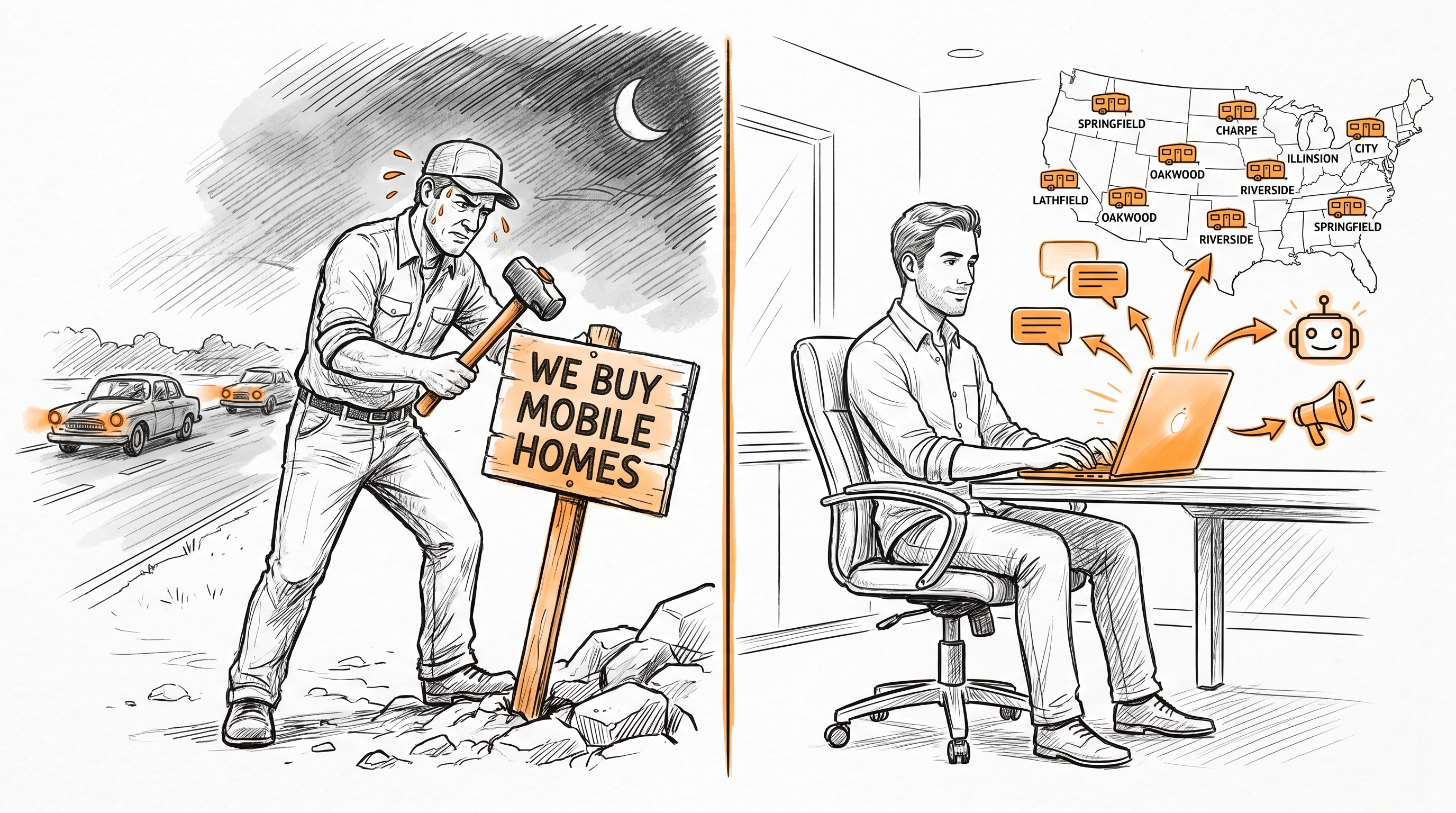
When I first started, I did what every new investor does. I ordered bandit signs from Amazon, wrote my phone number on them with "We Buy Mobile Homes," and put them out all over different towns and in front of mobile home park communities.
It always felt super awkward. I'd stop traffic to pull over on the side of the road. I ended up doing it at night because I was so embarrassed I didn't want to be seen putting them out. But then it was dangerous because people couldn't see me. So many times it felt like I was going to get hit by someone driving on the road who didn't see me walking there or parked on the side of the road. And remember, I was also working full-time. It was nights and weekends when I had to be out there, and it got really hard to do safely and to get enough of them out.
I was also trying to contact park managers and owners, which was pretty manual. Then I started sending out postcards and letters to homeowners. But it felt like a lot of money advertising to people who probably just didn't want to sell their homes.
Then I pivoted to paid ads. And everything changed.
I already knew how to run Google and Facebook ads from a previous business I owned with my wife, where I'd generated quite a bit of revenue from running ads. So I decided to try it on mobile homes. Within the very first week, I had someone not only click on my ad and submit a form but call in and basically tell me I could have their home for free. Just come down and get it. She sent me pictures and was chasing down my ad trying to sell.
I was early in my venture and just shocked. I thought it had to be a scam or too good to be true. But I made a point to follow up with every single lead. That decision turned into a $45,000 profit. I'll tell you the full story in a moment.
The point is this: bandit signs, postcards, and cold outreach can work. But paid ads changed the game for me because they reached people I never could have found any other way. Sellers in cities I'd never driven to. Sellers on ranches outside of town who'd never see a bandit sign. Sellers who were desperate but had no idea someone like me existed. If you're spending your nights putting out signs on the side of the highway, there's a better way.
The Shocker: A $7K Google Ad Deal Sold for $75K
Where to Find Motivated Sellers
There is no single magic channel. The investors who consistently find deals use multiple sources at once. I'm going to walk you through them in order from the hardest (most time, most effort, lowest return on your energy) to the easiest (scalable, automated, reaches sellers you could never find otherwise). Each one has its place. But knowing where each channel falls on this spectrum will help you spend your time where it actually pays off.
1. Bandit Signs (Hardest)
This is where most new investors start and where most of them burn out. Hand-written or printed signs with your phone number and "We Buy Mobile Homes" in bold letters. You put them out at busy intersections, in front of parks, and along major roads.
Can it work? Yes. I've had deals come from bandit signs. But the effort-to-reward ratio is terrible. You're spending nights and weekends on the side of the highway. You're dodging traffic and looking over your shoulder for code enforcement. Many cities now have ordinances against bandit signs and will fine you or make you take them down. And you're only reaching the small number of sellers who happen to drive past your sign in the few days it stays up.
If you have zero budget and zero other options, bandit signs can get your first deal. But plan on moving off of them the moment you can.
2. Park Manager Relationships
This one is complicated because, as you'll learn in the Park Problem section, many park managers are not working in the homeowner's best interest. But there are great park managers out there too. I work with community owners and managers nationwide who are honest, professional, and genuinely want the best for their residents.
Build relationships with the good ones. Let them know you buy and sell mobile homes. When a resident wants to leave or a home gets abandoned, you want to be the first call they make. One good park manager relationship can feed you deals for years.
The downside is that this takes time. You have to build trust. You have to show up consistently. You have to do right by sellers so the park manager feels good about referring you. This is a slow-burning channel, not a fast one.
3. Facebook Marketplace and Craigslist
Sellers post mobile homes for sale on Facebook Marketplace and Craigslist every day. Most of them are overpriced. That's fine. Your job isn't to buy the ones listed at fair market value. Your job is to find the ones that have been sitting for 60, 90, 120 days with no buyer. Those sellers are getting desperate. That's when you make your offer.
Sort by "oldest first" when you search. The fresh listings get all the attention. The stale ones are where the deals hide.
4. Driving for Dollars
Get in your car. Drive through every mobile home park in your area. Look for homes that are clearly vacant, run down, or have "for sale" signs. Write down the addresses. Then find the owners and reach out directly.
This sounds simple because it is. But almost nobody does it. You'd be amazed how many deals are sitting in parks right now, owned by people who want to sell but don't know how or don't think anyone would want their home. You showing up with a cash offer solves their problem.
The catch is that driving for dollars doesn't scale. You can only drive so many parks in a week. And it only works in areas you can physically get to.
5. Direct Mail and Cold Outreach
You can pull lists of manufactured home owners from public records and send them letters or postcards. "Are you thinking about selling your mobile home? I buy homes for cash." It's old school but it works. The response rate is low, usually 1 to 3 percent, but the leads that do respond are often highly motivated.
This is more scalable than bandit signs or driving for dollars, but it's still slow. You're paying per postcard, waiting for responses, and guessing at who might be motivated. It can be a decent supplement to other channels but rarely produces consistent deal flow on its own.
6. Word of Mouth and Referrals
Once you close a few deals, tell everyone what you do. Other investors, realtors, park managers, title companies, contractors. Every one of them knows someone who needs to sell a mobile home. Referrals are free and the leads are warm. The catch is you need to close a few deals first before the referral network kicks in.
7. Online Advertising: Facebook and Google Ads (Easiest and Most Scalable)
This is where the game changes. You run targeted ads to people who are searching for "sell my mobile home" or who fit the demographic profile of a motivated seller. When they click, they land on a page where they submit their information. You follow up immediately.
The key word there is immediately. Speed to lead matters more than almost anything else in this business. If someone fills out a form saying they want to sell their mobile home and you call them back three days later, someone else has already talked to them. You need to respond within minutes, not hours. This is one of the reasons I eventually built AI systems to handle initial follow-up. But when you're starting out, just be fast. Set your phone to notify you the second a lead comes in.
I want to tell you two stories here because they prove what paid ads can do better than anything I could explain in theory.
The first is a deal I call "The Shocker." I ran a Google ad in a city I'd never even visited. A seller responded saying she'd sold a previous home to a "We Buy Homes" franchise, so she knew the process. She didn't want to list on the market or go through a realtor. She said the home was trash, there were holes all throughout, and I should just tear it down. But if I wanted it, I could have it.
I thought it had to be too good to be true. But I followed up anyway. Did my due diligence. Made her send me her ID before driving an hour to see the home. Verified the title, confirmed no back taxes. When I got there, the home was a mess. Borderline hoarder conditions. Destroyed compressed-wood flooring. But the structure was intact, it was on a corner lot, and underneath all the damage, the home looked really nice. Comps in the area were $60,000 to $70,000 for a similar fixed-up home. I offered $7,000. She was shocked anyone would pay her that much. After rehab, I sold that home for $75,000 at full asking price. Over $45,000 in profit from one Google ad in a city I'd never set foot in before running that ad.
That deal never would have happened with bandit signs. Not in a million years.
The second story proves it even more. A ranch hand called me who had a year to remove his home from a property. He waited until two weeks before the deadline. The landowner had sold the property to a developer who was going to demolish the home with a skid steer if it wasn't moved, then sue the ranch hand for the demolition costs. This man had worked most of his life on that ranch. He was about to lose everything.
He said, "I just want the home removed so I don't get sued. You can have it."
The home was a wonderful doublewide with a huge new addition, new bathrooms, new tiled floors. I got it for free, paid the moving and storage fees, and sold it for $30,000 without any rehab needed.
That ranch was outside of town. This seller never would have seen bandit signs, never would have visited my website, never would have found a postcard in his mailbox. A targeted ad reached him at his most desperate moment. That's the power of paid ads.
How to Evaluate a Market
Before you spend money on ads or start driving parks, you need to know if your market is worth investing in. Not every city or area is a good fit for mobile home investing. Here's what to look at.
Population and job growth. Are people moving to this area or leaving? Growing markets mean more demand for affordable housing, which means more buyers for your homes. Shrinking markets mean longer days on market and thinner margins.
Number of mobile home communities. You want an area with a healthy number of parks. More parks means more inventory to buy from and more options for where to place or sell homes. If your area only has two parks and one of them has a terrible management company, your options are limited.
Average lot rent. High lot rent eats into the value of the homes because buyers factor monthly lot rent into their purchase decision. A home in a park with $500 a month lot rent is worth more than the same home in a park charging $900 a month. Know the lot rent range in your market before you start making offers.
Park ownership. Who owns the parks in your area? If they're all owned by the same corporate management company, you could be dealing with the same gatekeeper on every deal. Independently owned parks tend to be easier to work with, though that's not always the case.
Once you have your market picked and your channels running, you'll start getting leads. Next up: how to evaluate them so you never overpay.
You are hereChapter 04: How to Evaluate a Deal
1
Go Find
2
Go Estimate
3
Go Offer
4
Go Negotiate
5
Go Acquire
6
Go Dispo
7
Go Sell
8
Go Scale
Chapter 04
How to Evaluate a Deal
This is the section that separates investors who make money from investors who lose money. Everything else in this guide is useless if you can't accurately evaluate a deal before you commit your cash.
I learned this the expensive way. On my first deal, I underestimated the sale price and ended up holding a home for nine months while my lot rent bled $550 a month. I still made money because the buy-in was low enough to absorb my mistakes. But if I had run the numbers properly from the start, that deal would have been a $10,000 profit instead of a $2,600 one. The math doesn't lie. But it only works if you do it before you write the check.
Here's how to evaluate a mobile home deal step by step.
Step 1: Determine the ARV (After Repair Value)
ARV is what the home will be worth after you've finished all the repairs. This is the most important number in the entire equation because everything else flows from it. Get this wrong and nothing else matters.
The challenge with mobile homes is that comps are harder to find than in traditional real estate. There's no Zillow Zestimate that's accurate for a mobile home in a park. So here's how you actually figure it out.
Look at recent sales in the same park or similar parks nearby. Ask park management what homes have sold for recently. Check MyStateMLS, Facebook Marketplace sold listings, and Craigslist history if available. Talk to other investors and brokers in your area. The data is out there, but you have to dig for it.
Compare apples to apples. A 2005 singlewide in a park charging $600 a month lot rent is not comparable to a 2005 singlewide in a park charging $900 a month. Higher lot rent means lower home values because buyers factor that monthly cost into their purchase decision. Always adjust for lot rent differences, home size, age, and condition.
Do not use asking prices as your ARV. This is the mistake that will cost you the most money. Sellers on Facebook think their home is worth what they paid for it, or what their neighbor said it was worth, or some number they pulled out of thin air. Asking prices are fantasies. Sales prices are reality. Find out what homes actually sold for. That's your ARV.
Step 2: Estimate Your Rehab Costs
Walk the home. Look at everything. Then add 20% to whatever number you come up with, because something will surprise you. It always does.
I'm going to tell you about a specific issue here because it has caught me and many other investors off guard, and knowing about it before your first walkthrough could save you thousands.
Homes built around the year 2000 very commonly have compressed-wood subflooring. This material looks fine when it's dry. But if any moisture gets through to the wood underneath the laminate or stick-together flooring pieces, the compressed wood swells up like corkboard. It gets weak, becomes brittle, and breaks. Over time, you end up with floors you can barely walk on. Plywood patches covering holes in the bathroom. Plywood in the kitchen. The entire subfloor needs to be ripped out and replaced.
On my deal I call "The Shocker," this was the primary issue. The home was a year-2000 manufactured home and the compressed-wood flooring had been destroyed by moisture throughout the entire house. That flooring replacement alone cost $10,000. If I hadn't accounted for it, the deal still would have worked because I bought so far below value. But if my margins had been thinner, that surprise would have killed the deal.
When you walk a home from the late 1990s to early 2000s, check the floors carefully. Press hard in front of sinks, toilets, dishwashers, and anywhere water could have leaked. If the floor feels soft, spongy, or gives under your weight, plan on replacing the entire subfloor. Not just the damaged section. Once moisture gets into compressed wood, it spreads.
Here's a rough framework for common rehab items on a mobile home. These are ballpark ranges. Your market and contractors will vary.
Rehab Item
Typical Cost Range
Paint (interior)
$1,500 to $3,000
Flooring (carpet or vinyl)
$1,500 to $3,000
Subfloor replacement (compressed wood, full home)
$8,000 to $12,000
HVAC repair or replacement
$1,000 to $3,000
Plumbing repairs
$500 to $2,000
Electrical repairs
$500 to $3,000
Skirting
$1,000 to $2,500
Steps and porches
$500 to $1,500
Releveling
$500 to $1,500
Roof coating or repair
$500 to $2,000
Roof full replacement
$3,000 to $8,000
Kitchen/bathroom updates
$1,000 to $5,000
Belly board repair
$500 to $1,500
A light rehab on a singlewide might run $3,000 to $5,000. A full gut on a doublewide can easily hit $15,000 to $25,000. Know what you're walking into before you make an offer.
Step 3: Calculate Your Holding Costs
This is the one most new investors forget, and it's the one that killed my first deal's margins.
Holding costs are everything you pay every month while you own the home. In a mobile home park, the biggest one is lot rent. At $550 a month, my first deal ate $4,950 in lot rent alone over nine months. That's money straight out of your profit.
Here's what to include in your monthly holding cost calculation:
Lot rent ($500 to $900 per month in most Texas markets)
Insurance ($50 to $100 per month)
Utilities if you're keeping them on during rehab ($50 to $150 per month)
Any loan payments if you borrowed to buy the home
Add these up and multiply by how many months you expect to hold the home. Then add one extra month as a buffer. Homes almost always take longer to sell than you think.
Step 4: Run the Deal Math
Before I give you the mobile home formula, I want to show you how traditional real estate investors evaluate deals. Because the two formulas are very different, and understanding the difference will change how you think about this business.
The Traditional Real Estate Formula (the 70% Rule)
Every house flipper on BiggerPockets, HGTV, or Instagram uses some version of this formula:
Maximum Purchase Price = ARV x 70% minus Rehab Costs
The 30% buffer is the flipper's profit margin plus a cushion for unexpected costs. It works for traditional real estate because the dollar amounts are big. 30% of a $300,000 ARV is $90,000. Even after realtor commissions, loan interest, and holding costs, you walk away with real money.
This formula does not work for mobile homes in parks. Here's why.
30% of a $25,000 ARV is only $7,500. Now subtract your realtor commission (if you use one), your closing costs, the time and effort of managing the rehab, the months of lot rent while the home sits, and the risk of everything going sideways. You end up with a few thousand dollars of profit on a deal that ate 2 to 3 months of your life. That's not worth it.
Mobile home investors need better margins per deal to make this business work, because the absolute dollars per deal are smaller.
The Mobile Home Formula: Double Your Money
Here's the formula I use, and the one I teach to every investor I work with.
Your goal is to DOUBLE your total investment on every deal.
That means for every $1 you put in (purchase + rehab + holding costs), you want at least $2 back out.
Maximum Purchase Price = (ARV / 2) minus Rehab Costs minus Holding Costs
Same $25,000 ARV example, but with the mobile home formula:
ARV (based on recent park sales)
$25,000
ARV / 2
$12,500
Estimated rehab
$5,000
Estimated holding costs (3 months)
$2,100
Maximum purchase price
$5,400
If someone offers you this home for $5,000, you have a deal. If they want $10,000, walk away. The math is tighter on purpose. Because the absolute profit dollars are smaller in mobile homes, the percentage return has to be higher for the effort to be worth it.
Sweet-spot example: buy for $5,000, spend $5,000 in rehab, hold for 2 months at $1,000, sell for $22,000. Total in: $11,000. Profit: $11,000. That's doubling your money on a deal you can flip in 60 to 90 days.
When the Numbers Get Bigger
The "double your money" goal is cleanest on smaller deals ($5,000 to $15,000 purchase prices). As the deal size grows, the formula can stretch a bit.
If you're buying a home for $40,000 cash, you probably won't sell it for $80,000. That doesn't mean you should do the deal with thin margins. It means you need to be more disciplined. Aim for 70 to 100% return rather than strictly doubling, and make sure every number in your analysis is solid. Bigger deals have less margin for error.
When to Use the Traditional 70% Rule
If you're investing in manufactured homes on owned land (real property, not personal property in a park), those deals behave more like traditional real estate. They appraise like site-built homes, they can qualify for mortgages, and the deal sizes are typically much larger. For those deals, you can use the 70% rule as a reasonable benchmark.
But even then, I still recommend making sure your margins are better than the traditional minimum. The point of going into mobile homes is superior cash-on-cash returns. Don't give that advantage away by accepting thin traditional-flipper margins.
The Shocker: When the Math Works Perfectly
Now let me show you what happens when the math works perfectly. I'm sharing this deal because it proves two things: the formula works, and the best deals come from speed, due diligence, and following up on every single lead.
This is "The Shocker." A seller responded to my Google ad saying the home was trash and I could have it for free. After verifying her identity, checking the title, and confirming no back taxes, I drove an hour to look at it. The home was a mess on the surface. But I ran the numbers.
Comps for similar fixed-up homes
$60,000 to $70,000
Conservative ARV
$65,000
ARV / 2
$32,500
Estimated rehab (flooring, roof, paint, skirting)
$20,000
Estimated holding costs
$3,000
Maximum purchase price (double-your-money)
$9,500
The seller wanted to give it away for free. I offered $7,000 because I felt bad taking it for nothing when I knew the value that was there. I also wanted margin in case I found hidden issues like frozen pipes or structural damage. That $7,000 was comfortably below my maximum purchase price. That gap is your safety net.
Here's what actually happened:
Purchase price
$7,000
Rehab (flooring, roof, paint, skirting)
~$20,000
Holding costs
~$3,000
Total invested
~$30,000
Listed at
$75,000
Sale price
$75,000 (full asking)
Profit
~$45,000
I listed above comps at $75,000 to leave room for negotiation. The buyer came in at full asking price with lending. Loan approval took about a month, then I got the check for the full amount.
That deal worked because I bought well below my "double-your-money" threshold. $30,000 invested, $75,000 out. That's 2.5x my money. When you find a deal where the math works this well, move fast. They don't last. But notice something important. Even with a surprise roof replacement I didn't plan on, the deal still printed money because I had so much margin built in from the purchase price.
This is what I want you to internalize: your safety net is the gap between your actual purchase price and your max purchase price. The bigger the gap, the more mistakes you can make and still win. Mobile home margins are tighter than traditional real estate, so you have to be disciplined on the buy. Get the buy right, and almost every other mistake becomes survivable.
Step 5: Know When to Walk Away (and When to Pivot)
This might be the most important skill you develop. Not every deal is a deal. In fact, most aren't.
Walk away if:
The ARV is based on asking prices instead of actual sales.
The rehab costs are uncertain and there's no buffer in the numbers.
The park has a history of blocking sales or making the approval process difficult.
The lot rent is so high that it suppresses the home's value below your break-even point.
You're excited about the deal but the math says no. Trust the math.
I've walked away from more deals than I've closed. That's not a failure. That's discipline. The investors who lose money are the ones who talk themselves into bad deals because they don't want to feel like they wasted their time on the analysis. Your time spent analyzing a deal you walked away from is not wasted. It saved you thousands.
Before You Walk: Other Ways to Make Money on a Deal
Here's something most investors miss. Just because a deal doesn't work as a flip doesn't mean it's a bad deal. Before you walk away entirely, ask yourself if there's another way to make money on it.
List the home as the broker and earn a commission. If the seller needs to sell and you don't want to buy it yourself, offer to list it for them. In my brokerage, we charge a flat $3,000 commission. You do no rehab, take no ownership risk, and still walk away with a check. The seller gets professional marketing and a fair shot at market value. Everyone wins. This works especially well when the numbers are too thin for a flip but the home is in decent condition and sits in a cooperative park.
Wholesale it for a small fee. If there isn't enough margin for a full flip but you know another investor who would take it at a lower number, connect them with the seller and collect an assignment fee. Even a few thousand dollars on a deal you were going to walk away from is better than zero. Just be honest with the seller about what you're doing.
Negotiate the seller down or build in a price drop. Sometimes sellers are open to lower offers once they understand the market. If you're running the math and you're $5,000 apart from a workable deal, say so. "Here's what I need to make this work. If you're not there yet, I understand. Let me list it for you at your price. If it sits for 60 days, let's revisit my offer."
Try to sell first, then reduce. Get the home on the market at the seller's ideal price. If it doesn't sell in 30 to 60 days, come back to them with your lower cash offer. By then the seller has real market feedback and is usually more open to taking less. This lets you offer multiple exits to the same seller and build trust along the way.
The lesson here is simple. A "no" on a flip doesn't have to be a "no" on making money from the lead you worked so hard to generate. The deal you would have walked away from can still put a few thousand dollars in your pocket if you know how to pivot.
One Last Thing Before You Make an Offer
There's one more piece of evaluation that has nothing to do with math. Before you make any offer, you have to evaluate the park itself. You CAN do deals in hard parks. Plenty of great deals sit inside communities with terrible management. But if you're walking into a park that throws up red flags, you need to go in with your eyes open and use the Hard Park Playbook in the next chapter. Document every conversation. Know your rights. Know the eviction laws. A tough park does not mean a dead deal. It means a different playbook. The next chapter is that playbook.
You are hereChapter 05: The Park Problem
1
Go Find
2
Go Estimate
3
Go Offer
4
Go Negotiate
5
Go Acquire
6
Go Dispo
7
Go Sell
8
Go Scale
Chapter 05
The Park Problem
I need to be honest with you about something. This section is the one I'm most passionate about writing, and it's probably the most important section in this entire guide.
Before I get into the hard stuff, I want to say this clearly: many park managers are great. I work with community owners and managers nationwide who are honest, professional, and genuinely care about their residents. They run clean communities. They enforce reasonable rules fairly. They treat sellers and buyers with respect. They don't see residents as a resource to exploit. They see them as neighbors and customers. When you find one of these parks, cherish the relationship. Treat their team with respect. Do right by their residents. These parks will feed you deals for years because good operators want to work with good operators.
But sadly, many parks are going the other direction. More and more community owners are getting greedy. They've realized they can make enormous money by squeezing out existing homeowners, acquiring their homes cheap, and reselling them at full market value. And they've built whole playbooks around doing exactly that. Most sadly of all, the people who get hurt are the current owners. Real people. Families. Retirees. Single parents. Folks who trusted the system and got taken advantage of.
If you're going to invest in mobile homes inside communities, you will eventually deal with a park manager who is not working in the homeowner's best interest. Not might. Will. And if you don't understand the games they play, you will lose deals, lose money, and watch sellers get hurt by a system that's stacked against them.
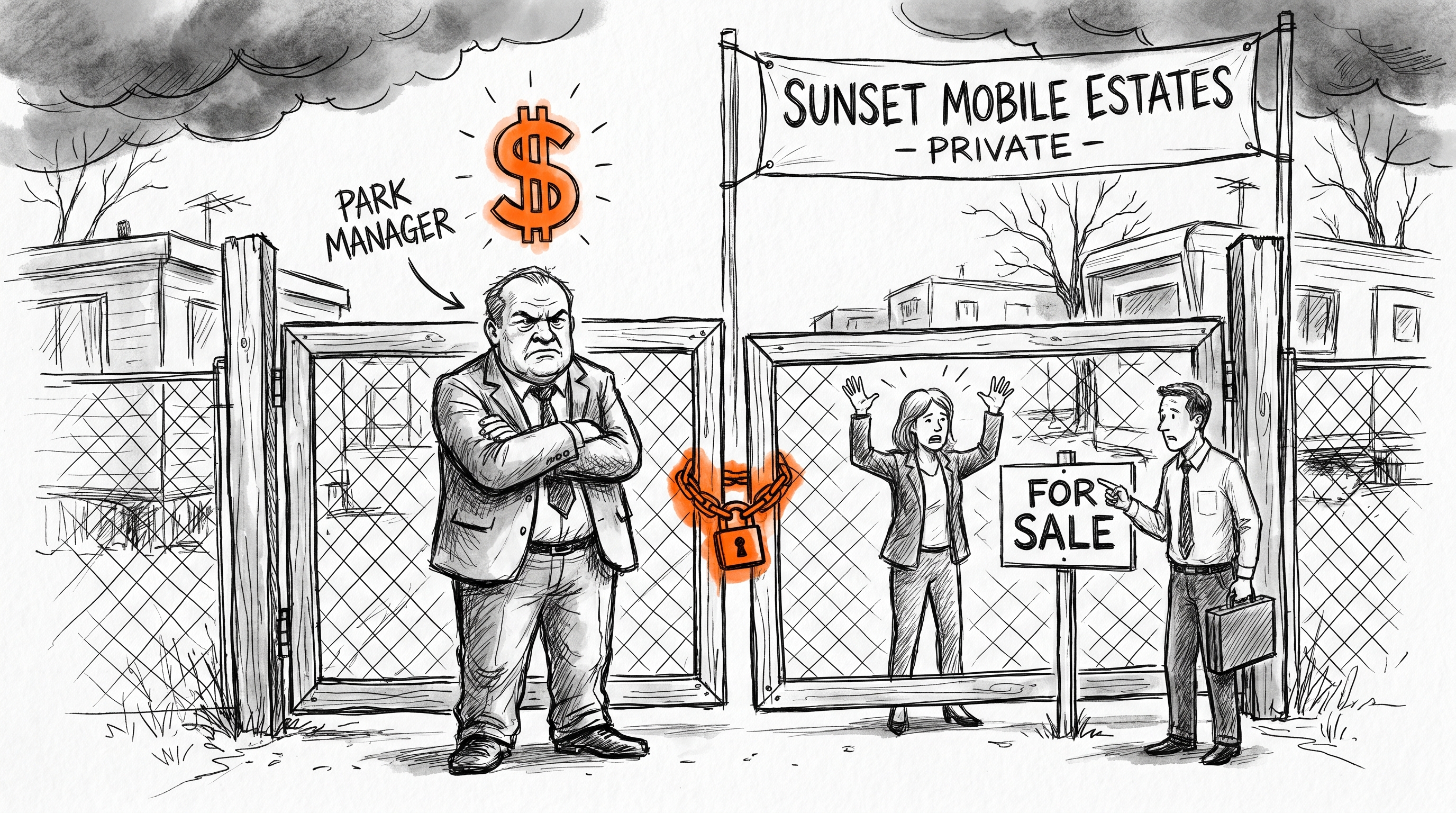
I've seen parks refuse to approve legitimate buyers for no real reason. I've watched them steer buyers away from private sellers and toward the park's own inventory. I've had sellers call me in tears because they've been trying to sell for months and the park keeps "losing" their buyer's application. I've seen parks tell homeowners their home is worthless and offer to "take it off their hands" for free, then turn around and sell that same home for $15,000.
This is not rare. This is common. And it's the reason I believe this industry needs to change.
Here are the specific tactics I've encountered, what your rights are, and how to fight back. And at the end of this section, I'll give you the red flags to look for when evaluating a park, and the green flags that signal a community worth working in.
Tactic 1: Refusing to Approve Buyers
This is the most common one. You find a buyer for your seller's home. The buyer is qualified, has cash or financing, and wants to move forward. You submit their application to the park. And then... nothing. The park delays. They ask for more documents. They "haven't gotten to it yet." Weeks go by. Sometimes months.
Meanwhile your buyer gets frustrated and walks away. Your seller is devastated. And the park acts like they had nothing to do with it.
In some cases they just flat-out deny the buyer with no explanation, or a vague one like "didn't meet our criteria." When you ask what criteria, you get a different answer every time.
Let me give you an example of how absurd this gets. I had a buyer lined up for a home I was selling on behalf of a client. This buyer was paying all cash. He walked into the park office, application in hand, ready to go. The park told him he wasn't approved because this would be his second home and they didn't believe he could "afford it."
Read that again. An all-cash buyer. Denied because they didn't think he could afford it. He had enough money in the bank to cover an entire year of lot rent on top of the purchase price. That wasn't enough. They denied him outright, wouldn't give a clear reason, and when he pushed back, they shut down the conversation completely. Wouldn't talk to him. Wouldn't talk to me. Just... done.
How can somebody not afford a house when they're paying in full cash? They can't. The park just didn't want a private sale to go through when they had their own inventory to move.
Tactic 2: Stealing Deals
This one makes my blood boil, because it happened to me personally.
I had a home under contract. A wonderful home, move-in ready, no repairs needed. Comps put it around $60,000. The seller had agreed to my offer of $28,000. This was going to be a great deal for everyone. The seller was happy, I was happy, and a future buyer would get a beautiful home at a fair price.
Then I told the community owner I was buying the home.
The park said the seller "wasn't allowed to sell" because she hadn't completed an external inspection first. This was strange, because the park already does annual inspections. But what they were really saying is that anyone trying to sell their home needs to come to the park first and get permission. And here's what happens when you do that.
The seller went in to comply with the inspection requirement, and the park told her, "Actually, we already have another buyer lined up. Would it be okay if you sold to them instead? We'll make sure the transaction goes really smooth." They reassured her it was better to work with the park's buyer than with me.
She called me and said, "I sold the home already. The park said they had somebody else."
Come to find out, I'm pretty sure the park acquired that home themselves and resold it. They took a $28,000 deal on a $60,000 home right out from under me. I believe they offered the seller even less than I was going to pay.
That was partly my fault. I should have gone in with the seller to make sure I was part of that conversation. If the seller or buyer is going to be talking to the park, you need to be there talking with park management too, so they can't steer things behind your back. Better yet, communicate by email so you have documentation you can use in court if needed. I learned that lesson the hard way.
The cycle is simple and it repeats everywhere. Block the private sale. Frustrate the owner. Acquire the home cheap. Sell it at a markup. Repeat.
Tactic 3: The Two-Tier Application System
This is the one that should make you angry, because it proves everything I'm telling you isn't just bad luck or disorganized office staff. It's a system.
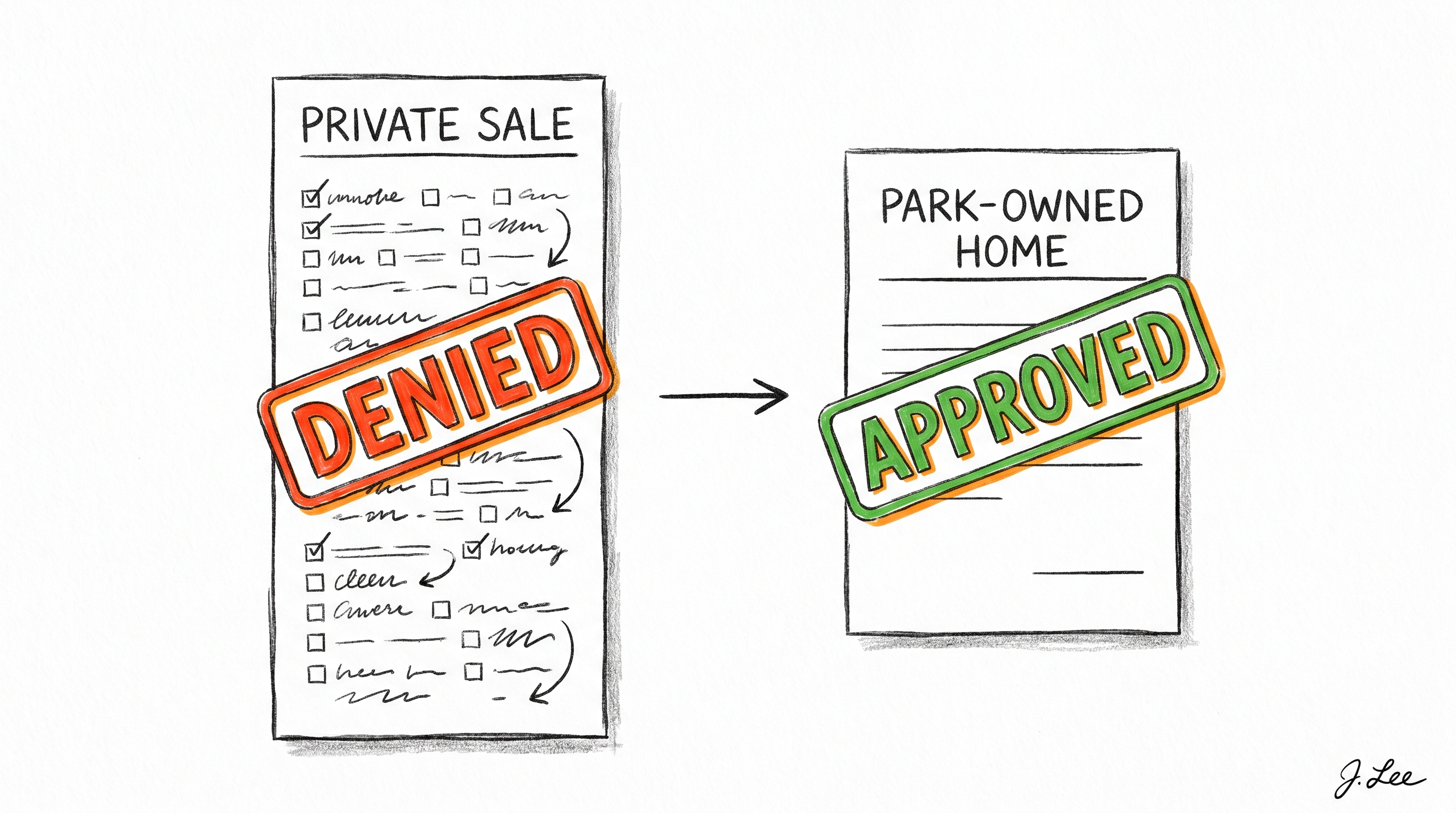
I had a second buyer lined up for that same seller's home after the cash buyer got denied. This buyer went in, submitted an application online, and got approved within three days. Easy. They went in to sign the new lease, feeling great about the process.
Then the park dropped the bomb: the online application was only for people buying a park-owned home.
Since my buyer was purchasing from a private owner, they needed a completely different application. Not online. Paper only. They had to come in person, bring two to three forms of ID, bring proof of income, and provide a cashier's check for a background check. None of that was required for the online application. The payment could have been made online. All of the paperwork could have been submitted online. But only if you were buying from the park.
If you're buying from the park, you get the red carpet treatment and approval in three days. If you're buying from another owner, you get treated like dirt and have to jump through hoops that don't exist for anyone else.
And even when buyers made it through all of that, which I've had some do, instead of three days for approval, private-sale applications went over 30 days. We'd call two weeks later and hear: "Sorry, it was under a pile of papers here. We actually didn't submit it yet. We'll submit it right now." Or: "Yeah, we submitted it. We're just waiting to hear back." Or: "Oh, we heard back. Sorry, we were going to reach out but got busy and forgot."
If that happened one time, I'd think it was a coincidence. Bad managers, not organized. But when it happens over and over, and I can see them treating buyers of park-owned homes wonderfully while treating people trying to sell their own homes horribly, that's a pattern. Their incentives are not aligned with the owners in the park.
Same park. Same homes. Same neighborhood. Two completely different application processes. One designed to fail. One designed to succeed. And the one designed to succeed just happens to funnel money directly to the park.
If that doesn't tell you everything you need to know about how some parks operate, nothing will.
Tactic 4: "Your Home Is Worthless"
This tactic is the one that keeps me up at night, because the people who fall for it are usually the ones who can least afford to lose.
More and more parks are realizing that the quickest way to increase the value of their community is to increase lot rent. And the quickest way to increase lot rent is to have newer homes on the lots. To do that, they need the old homes out. So they create conditions where owners can't sell through normal channels, which turns normal sellers into desperate ones.
Here's an example of what that looks like when it goes all the way. A park told a woman she could not sell her home. Not that they would help her sell it. Not that they'd work with her on finding a buyer. They told her she couldn't sell. Period.
Then the park had her sign what's called a "voluntary forfeiture." She just handed the home over. Signed it away for nothing. The park now owned the home, turned around, and sold it for a profit. The woman who owned that home didn't see a dime.
That's not a misunderstanding. That's not a gray area. That is a park lying to a homeowner to steal her property.
I've seen variations of this play out multiple times. Parks tell homeowners their home has no value. That nobody wants to buy it. That the park is "doing them a favor" by taking it off their hands. Owners who don't know their rights, who are tired and frustrated after months of being blocked from selling, give away homes worth $15,000 or $20,000 for nothing. The park puts $2,000 into it and sells it at full market value.
The Two-Tier Application System
Tactic 5: Selective Rule Enforcement
Every park has rules. Most of them are reasonable. The problem isn't the rules themselves. It's how they're enforced.
I've watched park managers enforce skirting requirements, yard maintenance rules, and parking regulations against sellers who are trying to list their homes while ignoring the exact same violations on homes the park owns. I've seen managers get into personal conflicts with residents and then suddenly start "enforcing rules" to push them out. Rules that nobody else in the park is held to.
One owner at a park I worked with asked the park to help sell her home. They said sure, they'd put it on their website. Sounds helpful. But what actually happened was that when buyers came into the park asking about available homes, the park showed all of their own homes and never mentioned this seller's home. After six to nine months of that runaround, the seller finally gave up on the park and listed with me instead. We got multiple showings, multiple offers, and a cash offer within two months.
It just goes to show that a park "helping" you sell is often a park keeping your home invisible while they sell their own inventory.
When rules and "help" are applied selectively, they stop being rules. They become weapons.
What Are Your Rights?
Here's what many homeowners and investors don't know: in most states, the park cannot unreasonably deny a buyer. The homeowner owns the home. The park owns the land. The park has a right to vet potential residents, but they do not have the right to block a sale just because they want to buy the home themselves or because they don't like the homeowner.
The specific laws vary by state. In Texas, the TDHCA (Texas Department of Housing and Community Affairs) regulates manufactured home transactions and provides resources for homeowners. Other states have their own agencies. Look up your state's manufactured housing regulations before you do your first deal.
Here's the bottom line: homeowners have more rights than most park managers want them to know. Your job as an investor is to know those rights and help your sellers exercise them.
The Hard Park Playbook
You can't avoid parks entirely if you're investing in mobile homes. Sooner or later, you'll find yourself doing a deal in one of the difficult ones. When that happens, you use this playbook. I reference the Hard Park Playbook throughout the rest of this guide, and this is where you come back to read it. It's the playbook I developed after working with over 100 clients. Use these steps any time you're dealing with a park that isn't cooperative.
1. Research the park before you commit to a deal. Talk to current residents. Ask about their experience selling homes. Ask if they've had buyers denied. If the park has a reputation for blocking sales, factor that into your offer price or walk away entirely.
2. Never let the seller talk to the park alone. I learned this the hard way when a park stole my $28,000 deal. If the seller or buyer needs to communicate with park management, you need to be in the room. Better yet, keep everything in email so you have a paper trail you can use if things go sideways.
3. Submit clean, complete applications. Don't give the park any legitimate reason to deny or delay. Make sure your buyer's application is filled out perfectly, all supporting documents are included, and the fee is paid exactly how they require it. Remove every excuse.
4. Follow up relentlessly. If you submit an application and don't hear back in a week, follow up. If they say it's "in process," ask for a specific timeline. If they miss that timeline, follow up again. Be professional but persistent. Parks count on people giving up.
5. Document everything. Every conversation with park management. Every application submitted. Every fee paid. Every timeline given. Keep it all in writing. Email is better than phone calls because it creates a paper trail automatically. If a park manager tells you something verbally, follow up with an email confirming what was said. You want a record that holds up in front of a judge.
6. Know when to escalate. If a park is clearly acting in bad faith, you have options. File a complaint with your state's manufactured housing authority. Consult with an attorney who specializes in manufactured housing law. Or consider the nuclear option.
7. The nuclear option: move the home out. If a park absolutely will not cooperate and the home is structurally sound enough to transport, you can move it to a different park or onto private land. I've done this. I once threatened to rip a home out of a park entirely, and suddenly they approved my buyer that same day. It's expensive and it's a last resort, but sometimes it's the only way to get a fair outcome for the seller.
The most important thing is this: don't let parks intimidate you. They count on investors and homeowners not knowing their rights. They count on people giving up. When you show up informed, documented, and persistent, the dynamic changes. Not every park is bad. But the bad ones are really bad, and you need to be ready.
How to Spot a Bad Park Before You Commit
Before you put a home under contract in any community, you need to know what you're walking into. Most of the pain I just described can be avoided if you read the warning signs early. Here's what to look for.
Red Flags in a Community
Not every park is worth doing business in. Here are the warning signs that a community will cost you more than it pays you.
Management that won't return calls or answer questions. If you can't get a straight answer about their application process, lot rent, or community rules before you even have a deal, imagine what it will be like when you have money on the line.
Excessive or unusual fees. Application fees over $50 to $75, transfer fees, "processing fees," or any fee that seems designed to discourage sales rather than cover actual costs.
Different processes for buying from owners versus buying from the park. This is the biggest red flag of all. If the park makes it easy to buy their homes and difficult to buy from private owners, they are not acting in the homeowner's best interest. Everything I just walked you through flows from this one misaligned incentive.
Visibly deteriorating infrastructure. Roads falling apart, broken street lights, overflowing dumpsters, standing water. If the park isn't maintaining the common areas, they're not investing in the community long-term.
High turnover. Lots of vacant homes and empty lots means people are leaving. Find out why before you invest.
Green Flags in a Community
When you find a park that hits these marks, build the relationship. Do more deals there. These are the communities where everyone wins.
Responsive, professional management. They answer your calls, provide clear information about their process, and treat homeowners fairly. These parks are gold.
Well-maintained common areas. Clean roads, mowed grass, working amenities. This tells you management cares about the community, which means your homes will sell faster because buyers actually want to live there.
Stable or growing occupancy. Most lots are filled. There's a waiting list or steady demand. Your homes won't sit on the market.
Reasonable lot rent with modest annual increases. Lot rent in the $500 to $700 range with small, predictable increases is healthy. Lot rent that jumps $100 a year is a warning sign.
Transparent rules and consistent enforcement. The rules are written down, available to review, and applied the same way to everyone. You'd be surprised how rare this is.
The parks that check all the green-flag boxes are the ones I keep coming back to. Find them in your market. Build relationships with the managers. Do honest deals. That's how you build a business that works long-term instead of constantly fighting fires.
Good parks or hard parks, at some point you'll need to make an offer, negotiate a price, and actually take ownership of the home. The next chapter walks you through all three: Go Offer, Go Negotiate, and Go Acquire.
You are hereChapter 06: From Offer to Keys
1
Go Find
2
Go Estimate
3
Go Offer
4
Go Negotiate
5
Go Acquire
6
Go Dispo
7
Go Sell
8
Go Scale
Chapter 06
From Offer to Keys
You found the deal. You ran the numbers. You know the park. You know what you're willing to pay. Now comes the part most new investors mess up. Making the offer, negotiating the price, and actually taking ownership of the home.
Fair warning before we dive in. This chapter is information, not legal advice. Laws around purchase agreements, title transfers, lien searches, and disclosure requirements vary dramatically by state. Before you close your first deal, consult a real estate attorney or an experienced mobile home coach in your state. The cost of one consultation is nothing compared to the cost of getting this wrong. With that said, here's what works for me.
Go Offer: Make the First Move
The best offers start as a conversation, not a piece of paper.
When I have a deal I want, my default is to make a verbal offer first, using a soft range. Let's say I've run the math and I'd pay up to $15,000. I don't start with $15,000. I open with something like, "Based on what you've told me, the range might be around $7,000 to $10,000, but I'd need to look at it a little closer to be sure."
Why? Three reasons.
I might be wrong about what the seller would accept. Maybe they'd take less than I think.
I never want to offer more than I have to.
Starting soft protects my room to move up if they push back.
If they say "yeah, I'd take $7,000," we're done. I didn't need $15,000 to close the deal. That $8,000 just stayed in my pocket. If they push back and say "there's no way I'd take less than $12,000," I don't argue. I say "let me look at it a bit closer and see what I can do." Then I come back later with a stronger offer. The initial soft range tested the waters. Now I know where they actually want to be.
Always try to let them say their price first. One of my favorite questions on the phone with a seller is, "What were you hoping to get for the home?" Their number tells me everything. If it's lower than my max, I try to meet them there or go slightly under. If it's higher than my max, I say, "Man, that's a little high for what I'm seeing." Then I stop talking. Let the silence do the work. Most sellers will justify their number, ask what I was thinking, or come down on their own. You'd be amazed how often just not filling the silence saves you thousands.
Read "Never Split the Difference" by Chris Voss. He's a former FBI hostage negotiator who wrote the best book on negotiation I've ever read. If you're going to negotiate offers for the rest of your career, it's the best $15 you'll ever spend.
Go Negotiate: Close the Gap
Negotiating a mobile home deal isn't like buying a car. It's more personal. You're often talking to someone who's had a hard year, lost a family member, or is trying to figure out their next step. Respect that.
But also, don't be a pushover. Protect your numbers. Here's the framework I use.
Know your walk-away number before you start. The 70% formula from Chapter 4 gives you this. It's non-negotiable. If the deal crosses that line, you walk. This protects you from getting emotional in the moment.
Negotiate verbally first, then move to writing. Once you've reached a verbal agreement or gotten close, shift to email or text for the specifics. This creates a paper trail. Something like: "Just confirming we agreed to $12,000 purchase price, closing in 14 days, with a 7-day inspection contingency. Let me know if I have anything wrong."
Use silence. When someone gives you a number you don't like, don't counter immediately. Pause. Think. Ask a clarifying question. People feel pressure to explain themselves when you don't fill the silence. That's when they often drop the number on their own.
Get creative when the numbers are close. When a seller needs cash but the deal would be tight, I've done partial-payment offers that work for both sides. "I can't do $15,000 today, but here's what I can do. I'll give you $1,000 right now to help you move this week. I'll fix up the home and sell it. When it sells, I'll pay you the remaining $10,000."
That structure is a win-win. They get cash in hand fast to move, which is often what they actually needed anyway. I get time and capital to rehab without being leveraged on day one. And the seller stays part of the story instead of feeling like they got steamrolled. Creative offers aren't for every deal. But when a seller's real problem is timing, not price, having options like this can save deals that would otherwise fall apart.
Walk away if the math doesn't work. This is the hardest part. Politely. Respectfully. But firm. "I understand why you want $20K. That's fair. But my numbers just don't work at that price. I'd love to help if your situation changes. Here's my number." You'd be shocked how many of those sellers call back.
Go Acquire: Get the Title in Your Name
Once you've agreed on price, you enter the acquisition phase. This is where deals can get tangled, so let's walk through the key components step by step.
Important disclaimer: Everything below is information, not legal advice. Laws vary by state. Consult a real estate attorney in your state before your first deal.
Step 1: Write a Purchase Agreement
You need a written contract. Not a handshake. Not a text message. A real document with terms, dates, and signatures. If you've never written one, here are your options.
Use a template from your state's manufactured housing authority. In Texas, the TDHCA publishes forms.
Use an AI tool like Claude or ChatGPT to draft a purchase agreement tailored to your deal, then have a real estate attorney review it before you send it out. AI can save you hours of drafting, but attorney review is non-negotiable for your first few deals.
Buy a standard manufactured home purchase agreement template from a legal forms service.
What goes in the agreement:
Buyer and seller full legal names (exactly as they appear on their IDs)
Property description: VIN or serial numbers, year, make, model, HUD tag numbers, current location
Purchase price
Earnest money deposit amount and where it's held
Closing date
Inspection contingency period (typically 7 to 14 days)
Financing contingency if applicable (most MH deals are cash)
Title transfer responsibilities (who pays what, who files what)
Condition of sale ("as-is" in most cases)
Default terms (what happens if either party walks)
Signatures and dates
Step 2: Earnest Money Deposit
Even on a $5,000 home, having a small earnest money deposit tied to specific dates shows you're serious and protects both parties. Typical amounts range from $100 to $500 on smaller deals, up to 5% of purchase price on larger ones.
Tie the deposit to specific contingencies. If you walk before inspection contingency expires, you get it back. If you walk after, the seller keeps it. If the seller walks, you get it back plus other remedies specified in the contract.
Step 3: Inspection Contingency
Even on cash deals, I strongly recommend building in a 7 to 14 day inspection period. This lets you walk through the home thoroughly, check for hidden issues like belly wrap damage or floor rot, verify everything matches what the seller said, and confirm the title is clean. If something major shows up, you can renegotiate or walk without losing your deposit.
If you're buying for cash and you've already done a thorough walkthrough, you can waive inspection to make your offer more attractive. But only do this if your offer price is low enough to absorb surprises. Walking a home once and writing a check the same day is a great way to discover $8,000 in unexpected repairs on day two.
Step 4: Get Signatures
Electronic signatures (DocuSign, SignNow, PandaDoc) are the easiest and most common. Most mobile home purchase agreements can be signed electronically, and it creates a clean audit trail automatically.
In-person signatures are still necessary sometimes. Some older sellers don't use email. Some don't have a smartphone. Some just prefer paper. When you have to sign in person, bring two copies of every document, sign both, and give the seller one copy. Keep yours somewhere safe. Scan it the same day.
Either way, document and copy everything. Keep digital copies in the cloud. You'll thank yourself later.
Step 5: Verify the Seller's Identity
Get a copy of the seller's ID. Always. This confirms you're contracting with the actual owner, not someone pretending to be them. I had a deal once where a relative tried to sell a home that wasn't theirs. The ID caught it before I paid anyone. Never skip this step.
Step 6: Title Search
You need to know there are no liens, back taxes, or ownership disputes before you close. Here's where it gets state-specific.
In Texas, the TDHCA (Texas Department of Housing and Community Affairs) maintains the Statement of Ownership. You can pull records to verify ownership, check for liens, and confirm the home is clear to transfer.
In other states, the DMV or your state's manufactured housing agency maintains these records. Look up "[your state] manufactured home title search" to find the right office.
Personal property vs. real property matters. Most manufactured homes are titled as personal property, like a vehicle. That's the case when the home sits in a park on rented land. Personal property homes are titled through your state's housing agency or DMV.
Real property homes (permanently affixed to owned land with a recorded deed) are titled through the county clerk like traditional real estate. If the home is real property, use a title company. They handle title search, title insurance, and the closing itself.
Important catch: Most title companies won't close a personal-property mobile home deal because there's no deed involved. That means for park-based homes, you're often transferring title directly through your state agency yourself. This is a big part of why mobile home investors learn to handle closings personally rather than hiring it out.
Check your state and local rules. Every state handles this a little differently.
Step 7: Consider a Lien Check
Even if your state database shows the home is clear, consider paying for a UCC (Uniform Commercial Code) lien search to catch anything not in the state manufactured housing system. It's typically $20 to $50 and can save you from buying a home with a hidden creditor's claim.
Step 8: Close the Deal
Agree on closing location, time, and payment method.
Bring your payment (cashier's check, wire transfer, or other agreed method).
Sign all final paperwork (bill of sale, title transfer forms, any addendums).
Collect all keys, remotes, and manuals from the seller.
File the title transfer with your state agency or the county clerk, depending on property type.
Get the title issued in your name. You don't actually own the home until this step is complete.
Step 9: Document Everything
Scan or photograph every single piece of paperwork. Keep digital copies in cloud storage. You'll need these for taxes, for resale, for any future disputes, and for your own records. Build this habit from day one.
When You Need a Coach: John Fedro
I'm going to be honest with you. This chapter gives you the basics. But if you've never done a mobile home deal before, and all this talk of purchase agreements, title transfers, lien searches, TDHCA filings, and state-specific rules is making your head spin, consider getting a coach. There is no shame in this. Every successful investor I know had someone in their corner when they did their first few deals.
I highly recommend John Fedro. John has been mentoring mobile home investors for over two decades. He has a full course that walks you through every step of the process, plus personal coaching options. When I was starting out, resources like John's filled in the gaps that no guide can cover for every state and every situation. He's seen every weird scenario this business can throw at you, and he'll save you from making expensive mistakes.
His coaching is worth every penny. If you're serious about doing deals, don't wing it alone. The money you spend on a good coach will come back to you on your first or second deal, and you'll have someone to call when something weird happens. Because in this business, something weird always happens.
What's Next
You've made the offer. You've negotiated the price. You've acquired the title. The home is yours. Now you have to turn it into something someone wants to buy, and get it sold for a profit. That's the next chapter.
You are hereChapter 07: How to Rehab and Sell
1
Go Find
2
Go Estimate
3
Go Offer
4
Go Negotiate
5
Go Acquire
6
Go Dispo
7
Go Sell
8
Go Scale
Chapter 07
How to Rehab and Sell
You found the deal. You ran the numbers. You vetted the park. You bought the home. Now you need to turn it into something a buyer actually wants to live in, and then find that buyer.
This is where the money is made or lost. A smart rehab on a tight budget can double your investment. A sloppy one with cost overruns and a bad contractor can eat your entire margin. And a home that's rehabbed beautifully but marketed poorly will sit on the market while your lot rent bleeds you dry month after month.
This section covers what to fix, how much to spend, how to find buyers fast, and a strategy most investors never consider: selling the opportunity instead of the finished product.
The Rehab: What to Fix and What to Skip
Here's a principle that will save you a lot of money: you are not rehabbing this home for yourself. You are rehabbing it to sell. Every dollar you spend should increase the sale price by more than a dollar. If it doesn't, skip it.
The items that matter most to buyers are the ones they see and touch every day. Flooring, paint, kitchen, and bathroom. Get those right and the home will show well. Buyers walk in, see fresh paint and new flooring, and they feel good about the home. That emotional reaction is what sells.
Here's my priority list for a typical mobile home rehab. Start at the top and work down. Stop when you hit your budget.
Must-do items (these sell the home):
Paint. Fresh interior paint transforms a home faster and cheaper than anything else. Budget $500 to $2,000 depending on whether you DIY or hire out. Exterior paint runs $1,000 to $3,500 and is worth it if the home looks rough from the street.
Flooring. Rip out old carpet. Luxury Vinyl Plank (LVP) has become the industry standard for mobile home rehabs and for good reason. It's waterproof, handles the chassis flex that manufactured homes are known for, and installs as a floating click-lock system, which means faster labor. Budget $950 to $3,650 for a full replacement depending on the size of the home and material quality. Do NOT install solid hardwood. Moisture from the underbelly migrates upward and causes warping and buckling. LVP looks just as good and actually survives.
Deep clean. If the home smells bad, it won't sell. Period. Clean everything. Replace anything that holds odor. Budget $200 to $500.
Kitchen updates. New hardware on existing cabinets, a new faucet, maybe new countertops if the budget allows. You don't need a gut renovation. Budget $500 to $2,000.
Bathroom updates. New toilet seat, new faucet, re-caulk the tub, new mirror. Small changes that make it feel clean. Budget $300 to $1,000.
Important items (these protect the home and pass inspection):
HVAC. Make sure it works. This is critical: mobile homes require mobile-home-specific furnaces and AC units. Standard residential units will not work because the home's smaller ductwork can't handle the airflow, and there's no crawl space or attic for a standard cabinet. A repair can run $100 to $3,000. Full system replacement runs $4,000 to $9,000. Get a $250 tune-up first and see if that solves it before replacing anything.
Plumbing. Fix any leaks. Make sure all fixtures work. Check under the home for belly board damage from water. Minor repairs run $175 to $450. If the home has old polybutylene or galvanized pipes, a full repipe with PEX runs $2,000 to $4,500 for a single-wide and $4,000 to $6,000 for a double-wide.
Electrical. All outlets and switches working. No exposed wiring. GFCI outlets in kitchen and bathroom. Minor repairs around $500. A panel upgrade or significant rewiring can run $1,500 to $4,000.
Skirting. Replace if damaged or missing. Skirting keeps animals out and insulation in. Most parks require it. Basic vinyl skirting runs $630 to $1,090 for a single-wide. If you're in a storm-prone area, consider insulated vinyl ($1,440 to $4,000) or faux stone ($660 to $1,000) for better durability and curb appeal.
Releveling. If doors stick or floors slope, the home needs leveling. Always hire a licensed set-up contractor for this. Jacking and raising a manufactured home is dangerous. Budget $500 to $1,500.
Skip these unless the budget allows:
Exterior cosmetics beyond skirting. A coat of paint on the exterior is nice but expensive and rarely changes the sale price enough to justify it on a quick flip.
Landscaping. Mow the grass. Maybe add a potted plant. Don't spend real money here.
High-end finishes. Granite countertops and stainless appliances in a $25,000 mobile home are a waste of money. Buyers at this price point care about clean and functional, not luxury. I'll tell you a story about this in a minute.
The Compressed-Wood Flooring Trap
If you're buying homes built around the year 2000, pay attention. A lot of manufactured homes from that era used compressed-wood subflooring. It looks fine when it's dry. But if even a little water gets through the laminate or vinyl on top, the compressed wood underneath swells up like corkboard, gets weak, becomes brittle, and breaks.
I bought a year-2000 home where this had happened throughout the entire house. You could barely walk through it. There was plywood covering holes in the bathroom, plywood in the kitchen. The floor was breaking everywhere. The seller thought the home was trash and wanted to give it away.
I paid $7,000 for a home with comps in the $60,000 to $70,000 range. Had the entire subfloor and flooring replaced for $10,000 by a contractor who understood how mobile homes are built. Then the roof turned out to need replacing too, along with paint and skirting. All in, I was still under $30,000. Listed for $75,000, sold at full asking price to a buyer with lending.
The lesson: compressed-wood flooring looks like a catastrophe, and that scares off most buyers and investors. But it's a known issue with a known fix. When you see it, run the numbers instead of running away. A $10,000 flooring job on a home everyone else thinks is worthless is one of the best margins in this business.
Strategy: "Sell the Dream"
Most investors assume the only path is: buy the home, fix it up completely, sell it to an end buyer. That works. But there's another strategy that can net you the same profit with a fraction of the time, money, and risk.
I call it "selling the dream." Instead of delivering a finished product, you sell the opportunity.
Here's the deal that taught me this. I bought a home from an owner who was moving. The home needed everything: new roof, new siding, new skirting, new floors, new paint, new appliances, electrical work, plumbing. The owner was happy to basically give it away. I paid about $500, because I wanted him to have something even though the condition arguably didn't justify it.
I looked at the numbers. I could spend $20,000 rehabbing this home top to bottom. If it sold for $30,000 more than my purchase price, that's only $10,000 in return on that $20,000 investment, and it would take months of contractor management, carrying costs, and stress.
Or I could fix the essentials, just the plumbing, sewer, and floors, for a couple thousand dollars. Make it livable. Then sell the opportunity for $20,000 to another investor who wanted to do the full rehab themselves.
That's what I did. I found an investment group of house flippers who were looking for new opportunities and were new to the mobile home space. Sold them the home for $20,000. I netted nearly the same profit without all the time, effort, and capital tied up in a full renovation.
Here's where the story gets even better, and it proves a point about over-rehabbing.
These flippers went in and made the home immaculate. New furniture, granite countertops, new kitchen, new bathroom, new cabinets. They basically rebuilt the entire home and tried to sell it for $130,000. They listed it during the holidays, which is already a slow period, and they marketed it like a traditional house instead of a mobile home. Poor timing, wrong approach, and way too much money sunk into finishes that buyers at this price point don't pay a premium for.
They came back to me for help. By that time, I was a licensed broker, so I listed the home, pushed it through my marketing platform, and got it sold within a month. I earned a broker commission on top of everything else.
Three transactions on one home. I bought it for $500, sold it for $20,000, then earned a commission selling it again. That one home just kept paying me.
The lesson is twofold. First, "sell the dream" is a legitimate strategy, especially in hot markets with active investors. You're selling potential, not a finished product, and the right buyer will pay for that potential. Second, over-rehabbing is a real trap. Granite countertops in a mobile home don't make it a $130,000 property. Know your buyer, know your market, and spend accordingly.
Overall Rehab Cost Ranges
To help you budget, here's a quick reference for what a full project typically costs depending on scope.
Scope
Typical Cost Range
Light cosmetic (paint, flooring, fixtures)
$5,000 to $10,000
Mid-range (add plumbing, electrical, some structural)
$8,000 to $22,000
Full rehab (older home, gut job)
$25,000 to $55,000+
Full gut-and-rebuild (double-wide)
Up to $70,000+
Most of the deals that make good money for investors fall in that light-to-mid range. If you're consistently spending $25,000+ on rehabs, you're either buying homes that are too far gone or you're over-improving them.
Managing Contractors
If you're not doing the work yourself, you're hiring someone. And hiring the wrong person is one of the fastest ways to blow your budget and timeline.
I got ripped off on my first deal by hiring bad contractors who botched the steps and skirting. I paid for the work twice. That mistake cost me thousands and months of time.
Here's what I've learned since then.
Get at least three bids for any job over $1,000. If one bid is dramatically lower than the others, be suspicious. Either they're cutting corners or they don't understand the scope.
Pay in stages, not upfront. Materials deposit, then progress payment, then final payment when the work passes your inspection. Never pay 100% upfront. I don't care how nice the contractor seems.
Check their work before you pay. Walk the job. Open every cabinet. Flush every toilet. Turn on every faucet. Test every outlet. If something is wrong, now is when you catch it.
Use handymen, not licensed general contractors, for most mobile home work. The scope of a mobile home rehab is smaller than a traditional home. You don't usually need a GC. A good handyman who has experience with manufactured homes is often faster, cheaper, and better suited to the work. The best referral I ever got was from a park manager I'd become friends with. That contractor understood how mobile homes are structured and built differently from traditional houses, which matters more than most people realize.
Check the belly wrap yourself. Every time. When the belly board is open during a repair, that's your only chance to inspect all the plumbing and ductwork underneath without cutting into it. Take pictures of everything you see. I've lost money trusting someone else's eyes on this.
How to Find Buyers
A rehabbed home sitting empty is costing you money every single day. You need to find a buyer fast. Here's what works, ranked by effectiveness.
1. Facebook Marketplace. This is the number one channel for selling mobile homes to end buyers, especially homes priced under $30,000 in a park. Post great photos, write a clear description, price it right, and respond to inquiries immediately. Most of your buyers are scrolling Facebook, not browsing MLS. Fair warning: as of 2023, business pages can't list directly, and you'll deal with a high volume of scammers and tire-kickers. Post from your personal account and be ready to filter.
2. MHVillage. This is the largest dedicated platform for manufactured home sales. Over 1,300 homes sell through MHVillage every week. The audience is specifically looking for mobile homes, which means less filtering and more serious buyers. It's where the industry shops. You should be listing every home here.
3. MLS (when it applies). If the home sits on owned land and is titled as real property, list it on MLS. This syndicates to Zillow, Realtor.com, and Redfin, which gives you the biggest buyer reach available. You can do this through a licensed broker or through a flat-fee MLS service for $300 to $400. Important: MLS only works for homes titled as real property. If it's a park home on a personal property or chattel title, MLS is not an option. Most realtors won't touch a mobile home on personal property title, so don't waste your time asking.
4. Signs in the park. Put a "For Sale" sign on the home and at the park entrance if management allows it. People drive through parks looking for homes all the time. Low-tech, but it works.
5. Your buyer's list. If you've been wholesaling first like I recommended, you already have a list of investors who buy mobile homes. Send them the deal. This is the fastest way to sell, especially if you're selling the dream instead of a finished product.
6. Word of mouth. Tell every park manager, investor, and real estate contact you have that you have a home for sale. One phone call to the right person can close a deal faster than weeks of advertising.
The standard combination for most mobile home investors is Facebook Marketplace plus MHVillage. Those two channels cover the vast majority of your buyer pool. Add MLS when the title situation allows it, and you've got the full picture.
Owner Financing as an Exit Strategy
I covered owner financing in the revenue models section, but it's worth addressing here because it directly affects how you sell. If your home is sitting on the market and traditional buyers aren't biting, offering owner financing dramatically increases your buyer pool. Many mobile home buyers have sub-prime credit and can't get a bank loan, but they can afford a monthly payment.
Before you do this, you need to understand the legal landscape. This matters.
The Dodd-Frank Act applies to all residential dwellings, including mobile homes. If you sell with owner financing, you are potentially acting as a "loan originator" and are subject to federal regulations. Here's what you need to know.
If you're a natural person (not an LLC) and you finance only one property in any 12-month period, you're exempt from loan originator licensing. No restrictions on balloon payments, interest rate type, or amortization. This is the simplest path.
If you're operating through an LLC or other entity and finance three or fewer properties in a 12-month period, you get a different exemption with strings attached. The note must be fully amortizing, no balloon payment allowed. The interest rate must be fixed for at least five years. And you must determine in good faith that the buyer has a reasonable ability to repay.
If you exceed three deals per year, you need a Mortgage Loan Originator license or you must work with a licensed loan originator. Many states require MLO licensing at even one deal, so check your state's implementation of the SAFE Act before you structure anything.
One more detail worth knowing: for manufactured home loans under $50,000, the "high-cost" loan threshold under Dodd-Frank is 8.5% above the Average Prime Offer Rate. That's higher than the standard threshold, which gives you more room on interest rates for the small-dollar deals that are common in this space.
The tradeoff with owner financing is always risk. You take on the role of the lender. If the buyer stops paying, you have to deal with it. Get a large down payment. Structure the note properly. And consult a real estate attorney in your state before you do your first owner-financed deal. This is one area where the cost of legal advice is nothing compared to the cost of getting it wrong.
One More Thing
Most homes you buy will stay right where they are. But sometimes the best deals are the ones you have to pick up and move, and that's a completely different game. The next chapter covers moving mobile homes, including when it makes sense, what it actually costs, and how to avoid the disasters I didn't.
You are hereChapter 08: Moving and Relocating
1
Go Find
2
Go Estimate
3
Go Offer
4
Go Negotiate
5
Go Acquire
6
Go Dispo
7
Go Sell
8
Go Scale
Chapter 08
Moving and Relocating
Moving a mobile home is one of the most misunderstood parts of this business. Most investors avoid it entirely. That is a mistake, because the deals you find on homes that need to be moved are some of the best deals in the entire industry. People who need a home moved are often desperate. They are emotional. They are running out of time. And they will practically give you the home if you can solve their problem.
I know this because my very first deal involved moving a home, and every single thing that could go wrong did go wrong. Overcharged movers. Wrong permits. Expensive park-approved contractors. Nine months of delays. I still made money, but barely, and only because the low buy-in gave me a buffer that a traditional investment never would have.
Here is what I have learned since then: about half of the homes I have sold where the home needs to be moved involve some kind of landowner versus homeowner dispute. Family fights. Evictions. Land sales. Divorces. People make emotional decisions, and those decisions create incredible buying opportunities for investors who know how to navigate the process.
This section covers when it makes sense to move a home, what it actually costs, and how to avoid the mistakes I made.
When to Move vs. Sell in Place
Moving a home is expensive and risky. You should only do it when the math clearly justifies it. Here is the decision framework.
Move the home when:
The home is in a park that refuses to cooperate with sales and you have exhausted every other option. Sometimes the nuclear option is the only option.
The home is significantly undervalued in its current location but would be worth much more in a different park or on private land.
You are buying a home on private land where the owner is selling the land separately, and the home needs to go somewhere.
The cost of moving plus setup in the new location still leaves you with a strong profit margin after all expenses.
Sell in place when:
The park is cooperative and will approve buyers.
The home is in decent condition and the market supports a good sale price where it sits.
Moving costs would eat too much of your margin.
The home is older or in questionable structural condition. Moving puts enormous stress on a manufactured home. Older homes can develop cracks, leaks, and structural damage during transport.
The general rule: if you can sell it where it sits, do that first. Moving is always the more expensive and complicated option.
The Landowner Disputes That Create Deals
Let me tell you about a deal that shows exactly how these situations play out.
A guy bought a brand-new doublewide, installed the septic, installed the site pad, installed all the utilities, and paid to have everything set up on his brother-in-law's property. Then they got in a fight. Probably over beers on a Saturday night, like any good hillbilly. The brother-in-law, who owned the land, said "You got to leave. Get off my property." And he actually went through the legal eviction process to force his own family member out.
This is sad, and I wish it would not happen, but it should serve as a warning to anyone considering buying a house and putting it on land they do not own, especially land owned by a family member. At the very least, have a solid contract that says you cannot get kicked out for silly reasons. But this happens far more often than you would think.
The homeowner was emotional and upset. But by being patient, talking through it with him, and being kind, I was able to help him get the home sold. We found a buyer who could pay for the move, lined it all up, and I worked as a mediator between the family members to get the title work signed and get permission for the mover to come in and remove the home from the property. Definitely some work involved, but a good deal that helped everyone.
I had another owner call me who had a full year to remove his home from a property. Why did he call me two weeks before the deadline? I have no idea. But that is when he decided to pick up the phone. The landowner had already sold the land to a developer who was going to come out with a skid steer and demolish the home if it was not moved. This man had worked most of his life as a ranch hand on the property, and now he was being forced out. They were going to sue him and charge him for the demolition. So he said, "You can have it."
That home was a wonderful doublewide with a huge new addition, new bathrooms, and new tiled floors. We got it moved and sold it for $30,000. I had to pay moving fees, storage fees, and everything in between, but I still made a nice profit without having to rehab the home at all.
Both of those deals came from targeted ads running at the right time. These sellers were in rural areas. They never would have seen bandit signs. They never would have visited my website. They saw my ad, clicked on it, called me, and we got deals done. If you are running the right ads, these deals will come to you.
What It Actually Costs
Here is where most people get taken advantage of. Movers know that most homeowners have never moved a mobile home before. They also know you are often under time pressure. So they double their prices for people who do not know the market. I have seen it happen over and over. The same move that costs an informed investor $5,000 gets quoted at $10,000 to someone who has never done this before.
Get multiple quotes. Always. And use the numbers below as your baseline so you know what is reasonable.
The overall average for a full-service move in 2025 is approximately $8,500. (Sources: First Choice Home Center, iMoving, Braustin, HomeAdvisor)
On my first deal, the mover and installer alone cost $4,500. Add permits, engineering, contractors, and materials, and the moving-related expenses were over $10,000. That is money that comes directly out of your profit.
Doublewides are especially expensive because the two halves have to be transported separately and then reconnected on site. The marriage line where the two sections meet needs to be sealed, finished, and inspected. This is specialized work.
Here is what a "full-service" move should include: utility disconnection (electric, water, sewer, gas), skirting removal, axle/wheel/tongue installation if they were removed, transport with escort vehicles, permits, setup at the new site (piers, leveling, anchoring), and utility reconnection. If a mover quotes you full-service and any of these are missing, they are going to hit you with add-on charges later. Get the scope in writing before you agree to anything.
The Insurance Gap Nobody Warns You About
This is critical and most investors learn it the hard way.
Your standard mobile home insurance policy does NOT cover the home during transport. Read that again. The moment that home goes on a trailer, your existing policy almost certainly excludes it. If the mover crashes, if a tire blows out and the home takes damage, if a tree branch rips off the roof, you could be completely unprotected.
Here is what you need to do before any move.
1. Verify the mover's cargo insurance. Request a certificate of insurance. Confirm the coverage amount matches or exceeds your home's value. If they cannot produce this, do not hire them. Period.
2. Ask your insurance company about trip/transportation coverage. This is a rider on your existing policy that covers collision damage during a specific move, usually for a 30-day period. Add it before the move.
3. Document everything before the home leaves. Photos and video of every wall, every corner, the roof, the belly board, the skirting. If you need to file a claim later, you need proof of the home's condition before transport.
This is one of those things that costs almost nothing to get right and can cost you the entire deal if you get it wrong. (Sources: Slawsby Insurance, Progressive, Mobile Agency)
How to Find a Reliable Mover
A bad mover can damage your home during transport, show up late, or not show up at all. Here is how to vet them.
1. Verify their license. You need a mover with a state transport license specific to manufactured homes. Not a general towing license. A manufactured home transport license. Ask for the number and verify it with your state's manufactured housing division.
2. Check their insurance credentials. You want minimum $300,000 general liability, cargo insurance covering the full replacement value during transport, and workers' compensation for all employees. If they are doing an interstate move, they need DOT operating authority too.
3. Get references and check them. Call other investors or park managers who have used them. A mover with a good reputation among local investors is worth paying a little more for. Ask for references from the last six months specifically.
4. Get everything in writing. The quote, the timeline, what is included, what is not included. Any verbal agreement is worthless if something goes wrong.
5. Do not automatically pick the cheapest bid. My first mover was not the cheapest, and they still overcharged me. But I have heard worse stories from investors who picked the lowest bid. Unusually low quotes often mean the mover is cutting corners on insurance, escort vehicles, or proper equipment. You get what you pay for.
Red flags to watch for: No state-specific MH transport license. Unwilling to provide proof of insurance. No physical business address. No written contract detailing scope of work. If you see any of these, move on.
The Permit Situation
This is where my first deal went sideways. I want to save you from the same mistake.
Every city and county has different permit requirements for placing a manufactured home. Some require a master building permit. Some require separate electrical, plumbing, and mechanical permits. Some require an engineering layout showing exactly where on the lot the home will be placed. Some require all of the above.
On top of that, you need a moving permit from the state DOT because a manufactured home on a trailer is classified as an oversize/overweight load. That permit confirms legal eligibility to move, verifies there are no outstanding tax liens, and proves clear ownership. Without it, a mover cannot legally transport the home.
If you are crossing county or state lines, you may need separate permits for each jurisdiction the home passes through. All of these must be secured before the move date.
Call the city or county building department before you commit to moving a home. Ask them exactly what permits are required for placing a manufactured home on the lot or in the park you are targeting. Get the list in writing. Get the costs. Get the timeline for approval.
If you show up with a home on a trailer and you do not have the right permits, you will be stuck. You cannot set the home up. You are paying lot rent on a lot you cannot use. You are paying storage if the home is sitting on a trailer somewhere. And the permitting process can take weeks or months.
I spent weeks dealing with permit issues on my first deal while paying lot rent and contractor fees. All because I did not make one phone call before the move. Do not repeat my mistake. Call ahead.
The good news: licensed movers typically handle all transport permits as part of their service. You are usually responsible for the destination-side permits (zoning, setup, utilities). Know which ones are yours and which ones are theirs before the move.
The 10-Step Setup Sequence
Once the home arrives at the new site, here is what happens, in order. Knowing this sequence helps you plan, budget, and hold contractors accountable.
Site preparation. Grading, compaction, and drainage. The ground needs to be level and stable before anything else happens.
Foundation or pier installation. Steel or concrete block piers are most common. Concrete block piers over 36 inches high must be configured as double-block piers. Anything over 80 inches requires an engineer's design.
Home placement on foundation. The mover positions the home on the piers.
Marriage of halves (doublewides only). The two sections are bolted together at the floor, roof, and walls.
Leveling. Using a water level or laser level. Each side of a doublewide must be leveled independently. This step is critical. If the home is not level, you will have doors that will not close, cracks above windows, and marriage line separation.
Anchoring and tie-down installation. All anchoring equipment must resist a minimum working load of 3,150 lbs. The number of anchors depends on the home's wind zone rating. Earth auger anchors are typically installed five feet deep. A properly tied-down manufactured home can withstand 110+ mph winds.
Utility connections. Water, sewer, electric, gas.
Skirting installation.
Steps and landing installation.
Final inspection by local building department.
Do not let anyone skip steps or reorder this sequence. I have seen installers try to anchor before leveling, or skip the inspection entirely. Every shortcut creates a problem you will pay for later. (Sources: Alabama MHA, HUD Foundation Guide, Mobile Home Living, Oliver Technologies)
Things That Go Wrong
I want to be upfront about this. Here are the most common problems with moving mobile homes.
Damage during transport. Ceiling cracks and tape joint separation from road vibration. Marriage line gaps on doublewides when the halves shift. Window and door frame stress cracks. Broken siding. Plumbing joint separation under the belly. Belly board sagging or tearing from road debris. If the home was not properly prepared for transport, things shift and break.
Setup delays. The lot is not ready. Utilities are not connected. The installer cannot come for two weeks. Every day of delay is money.
Park-controlled vendor lists. Some parks require you to use their approved contractors for setup and installation. These contractors charge a premium because they know you have no other option. This is what happened to me. Factor this into your cost estimates.
Weather. You cannot move a mobile home in high winds or severe weather. A move scheduled for Tuesday might get pushed to the following week because of a storm. Build buffer time into your plan.
The home fails inspection. After setup, most jurisdictions require an inspection before the home can be occupied. If it fails, you are doing rework on the installer's or contractor's dime if you are lucky, or on yours if you are not.
One more thing worth knowing: movers do not require wheels underneath the home. As long as there is a frame, movers can usually get axles and wheels and hook up to it. That is pretty common, at least here in Texas. Do not assume a home without wheels cannot be moved.
The Bottom Line on Moving
Moving a mobile home can be a powerful tool. It lets you rescue homes from bad parks, take advantage of deeply discounted homes that need relocation, and create value by placing homes in better locations.
But it is not for beginners. Your first few deals should be homes that stay where they are. Learn the rehab process. Learn the selling process. Learn how parks work. Then, when you have some experience and capital, consider adding relocation to your toolkit.
When you do, budget generously, permit early, vet your mover carefully, verify insurance on both sides, and expect something to go wrong. If nothing goes wrong, consider it a bonus. And run targeted ads consistently, because the best moving deals come from desperate situations where someone needs a problem solved fast. Be the person who solves it.
You are hereChapter 09: Development, New Homes & Land
1
Go Find
2
Go Estimate
3
Go Offer
4
Go Negotiate
5
Go Acquire
6
Go Dispo
7
Go Sell
8
Go Scale
Chapter 09
Development, New Homes & Land
Everything we have covered so far focuses on buying and selling individual mobile homes inside communities. That is where most investors start, and it is where the fastest money is made with the least capital.
But there is a bigger game. If you are thinking long-term, if you want to build real equity and recurring revenue, this section is where things get interesting. Development, selling new homes, and structuring land-and-home packages are the paths that take you from "mobile home flipper" to "manufactured housing business owner."
I am going to be honest. This section goes beyond what most first-time investors need. If you are just getting started, bookmark this and come back after you have done your first few deals. But if you are the kind of person who wants to see the full picture before choosing a starting point, keep reading.
Developing Land for Manufactured Homes
The single most powerful play in manufactured housing is owning the land.
When you own the dirt, you control the rules. No park manager can block your sales, raise your lot rent, or deny your buyers. You decide who lives there, what the community looks like, and how much you charge. Every problem I described in the Park Problem section disappears when you own the land.
The best development model works like this: buy a piece of land zoned for manufactured homes, prepare the lots with utilities (water, sewer, electric), install move-in-ready homes, sell the homes to individual buyers, and rent the lots. You collect lot rent every month from every homeowner on your land. That is recurring revenue with very little ongoing maintenance compared to renting the homes themselves.
Here is the reality check. Jurisdictions are making it harder to develop new mobile home parks. Zoning restrictions, NIMBY opposition from neighboring property owners, and lengthy permitting processes can kill a project before it starts. Building a new lot from scratch costs approximately $15,000 per pad site just for the infrastructure (road frontage, concrete parking pad, water, sewer, power, and gas connections). That does not include land acquisition, engineering, tap fees, common areas, or amenities. You are looking at 12 to 24 months for zoning approvals in most jurisdictions.
So here is the smarter approach that I recommend. Instead of developing raw land, find a small existing park that is already grandfathered in with the local municipality. Buy it. Then add homes to vacant lots, or subdivide existing lots if the zoning allows. You skip the zoning fight entirely because the park already has its approvals.
There is some good news on the legislative side. States like Maine, Maryland, and New Hampshire have recently passed laws that legalize manufactured housing wherever single-family dwellings are allowed or prohibit municipalities from entirely restricting manufactured housing. This trend is growing as more states recognize manufactured homes as a real solution to the affordable housing crisis.
A Quick Example of Creative Development
One of my favorite land deals started as a simple mobile home on acreage. We got the property under contract at $350,000 after negotiating down from $450,000. During our 90-day due diligence, we discovered the property had city sewer and city water (not septic), and the city told us the zoning could be changed from agriculture to commercial, making it eligible for an RV park.
We never actually developed it. We marketed the property as an RV park opportunity with our due diligence findings and wholesaled it for $450,000, making $100,000 profit without putting a penny out of pocket. No contractors. No rehab. Just organized the deal, did the research, and had the knowledge to put it together.
That deal illustrates what I call the "waterfall effect." When you are dealing with land, you can have multiple exit strategies layered on top of each other. If one does not work, another might. Buy a four-acre property to put a mobile home on it, and if that costs more than you thought, maybe the county allows you to put more homes on it, or you could subdivide into different parcels and change the economics entirely. More options means more ways to win.
Selling New Manufactured and Modular Homes
If you learn the development side of this business (septic installation, utility hookups, permitting, site prep), you can partner with manufacturers to sell new homes directly to landowners. This is the dealer model, and the margins can be significant.
We work with lots of dealers and developers in this space. There is consistent demand from people who own land and want to place a manufactured or modular home on it. If you can help them navigate the process from purchase through installation, you become extremely valuable.
Here is my strong recommendation if you go this route. Push modular homes over manufactured homes whenever the buyer can afford it. The numbers make it obvious why.
Look at those numbers. A manufactured singlewide averages $81,281. A modular home runs $150,000 to $350,000 but gets appraised, financed, and appreciated exactly like a stick-built home that would cost $300,000 to $500,000+. Manufactured homes cost roughly 66% less than median site-built homes. But modular homes give your buyer real-property status and conventional mortgage access at 10% to 25% less than site-built. For buyers who can stretch a little further, modular is the better long-term deal every time.
If a buyer can afford a new manufactured home, they can almost certainly afford a modular home instead. The price difference is often smaller than people think, and the long-term value retention makes it a much better deal for the buyer.
FHA Loan Limits Got a Massive Upgrade
In March 2024, FHA raised its manufactured home loan limits for the first time since 2008. The new numbers: $148,909 for a single-section and $193,719 for a multi-section. The old limits were $69,678 and $92,904. That is roughly a 114% increase for singlewides and a 109% increase for doublewides. This opens up financing for a huge segment of manufactured home buyers who were previously locked out. If you are selling new homes and your buyers are using FHA, these numbers matter.
The Depreciation Reality
I have said this before and I will say it again because it is that important.
If someone is buying a mobile home on rented land or in a park, I do not recommend buying new. The depreciation on a new manufactured home is brutal. Here is what actually happens to the value.
Period
Annual Depreciation
Cumulative Loss
Year 1
~12.5%
12.5%
Years 2 through 5
~5% per year
~32.5% after 5 years
Years 6 through 20
~3% per year
~75% to 80% after 20 years
(Sources: MobileByeBye, Hames Homes, Aspire Communities, Santiago Financial)
That is not linear. It is an exponential curve that drops steeply in the first one to three years, continues falling through about five years, then slows down through year ten, takes another dip, and then levels off. Just like a car driving off the lot.
Five years in, a new manufactured home has lost roughly a third of its value. The buyer still owes most of their loan balance. They are underwater. This is a terrible position for the buyer, and if you are the one who sold it to them, it reflects on you.
Here is my recommendation, and it comes from doing this hundreds of times.
If you are buying a home to live in yourself, buy at least five years old. You skip the steepest part of the depreciation curve and save a fortune.
If you are buying to rehab and flip, the sweet spot is 10 to 20 years old. At that point, you can usually get the home fairly cheap, fix it up, and sell it for still quite a bit less than what a new mobile home would cost. The depreciation has already happened. Your buyer gets a great deal. You make your margin. Everyone wins.
Save "new" for situations where the buyer owns the land. When the home sits on owned land, it can be titled as real property rather than personal property. It gets a deed instead of a title. It qualifies for traditional mortgages. And it appreciates with the land over time instead of depreciating against it.
There is a growing argument in the industry that the blanket "manufactured homes always depreciate" assumption no longer holds universally. Recent 2024 and 2025 market data shows many manufactured homes holding value or appreciating, especially in tight housing markets. The biggest factor is land ownership. Homes on owned land can and do appreciate. Homes in parks on leased land are still much more likely to depreciate.
Land-and-Home Packages
A land-and-home package is exactly what it sounds like: you sell the buyer a piece of land with a home already on it, or ready to be placed on it. This is the best deal for the buyer because they own everything. No lot rent. No park rules. No risk of a management company making their life difficult.
The financing structure matters enormously here. When the home is permanently affixed to owned land and titled as real property, buyers can get a single combined loan (conventional, FHA, VA, or USDA mortgage). According to Pew Charitable Trusts research, this saves approximately $49,000 over the life of a $100,000 loan compared to chattel financing, with monthly payments roughly 10% lower.
To qualify a manufactured home as real property, you typically must own the land, permanently affix the home to a HUD-approved foundation, remove the wheels, axles, and tongue, convert the title from DMV/vehicle title to a real property deed, and file an affidavit of affixture with the county.
For investors, land-and-home packages represent a higher capital investment but also higher margins and a more stable product. Buyers who own their land are more committed, more likely to maintain their property, and less likely to default on financing.
If you are at the stage where you are buying land, installing homes, and selling packages, you are no longer flipping mobile homes. You are a real estate developer. And the skills you learned flipping homes in parks are the foundation that got you here.
Where This Fits in Your Journey
Development, new home sales, and land packages are not where you start. They are where you grow.
Start by flipping or wholesaling homes in parks. Learn the market. Build your capital. Understand the industry. Then, when you have the experience, the capital, and the appetite for bigger projects, look at development as your next move.
The investors I work with who have built the most wealth are the ones who started small, learned the fundamentals, and then expanded into land ownership and development over time. They did not skip steps. They earned each one.
You are hereChapter 10: Brokering
1
Go Find
2
Go Estimate
3
Go Offer
4
Go Negotiate
5
Go Acquire
6
Go Dispo
7
Go Sell
8
Go Scale
Chapter 10
Brokering
Development is the long-game endgame in this business. But most investors will never get there without first building the cash flow and systems to fund it. This chapter is about the single most scalable path to that cash flow, and the one I took myself: brokering.
There came a point in my flipping career where I hit a wall. I was running two to five flips at a time. I was making good money. But I was also personally answering every seller call, walking every home, managing every contractor, coordinating every showing, and handling every piece of paperwork. My phone never stopped. My weekends disappeared. And no matter how hard I worked, I was capped at what I could physically do myself.
That's when I got licensed and started brokering. And everything changed.
At peak, I was managing 50 to 100 listings at the same time without lifting a single hammer. I went from flipping homes to running a business. From fixing toilets to closing deals. From being the product to selling the product. If you ever want to scale beyond what one person can physically do, brokering is one of the fastest paths to get there.
This section walks you through what brokering actually is, how to get licensed, what you can charge, and who this model is built for.
What Brokering Actually Does
A licensed manufactured home broker represents sellers or buyers in the sale of a mobile home. You don't own the home. You don't rehab it. You don't take on the risk of the transaction. You provide the service of getting it sold, and you earn a commission when the deal closes.
That one distinction changes everything. When you're flipping, your money is tied up. Your time is tied up. You're exposed to the market. If a flip goes sideways, you eat the loss. When you're brokering, the home belongs to the seller. The money belongs to the buyer. You're the professional who connects them, markets the home, negotiates the terms, handles the paperwork, and gets everyone to closing. Your capital stays free. Your risk is minimal. And you can do this on 50 homes at once instead of five.
How to Get Licensed
Here's something critical to understand before you go any further: every state handles manufactured home licensing differently. There is no federal license. There is no "one-size-fits-all" path. What works in Texas won't work in Florida, and what works in Florida doesn't apply in California. Before you do anything, you have to look up what your specific state requires.
There's also an important distinction most people miss. In traditional real estate, you need a real estate agent or broker license (regulated at the state level, usually overseen by each state's real estate commission). Those licenses typically cover site-built homes and land. But manufactured homes, especially those titled as personal property (not attached to land), often require a separate, specialized license because they're treated legally more like vehicles than real estate. That's why a regular realtor can't legally handle a park-based manufactured home sale in many states. They'd need the manufactured-home-specific credential on top of (or instead of) their real estate license.
Let me walk you through three examples to show you just how different the rules can be.
Example 1: Texas
Texas is where I'm licensed, so I know this one cold. Manufactured home transactions are regulated by the TDHCA (Texas Department of Housing and Community Affairs). I hold a Manufactured Home Broker license, number MHDRET00038000. To get this license in Texas, you complete pre-licensing education, pass a state exam, pay your fees, maintain a surety bond, and complete ongoing continuing education. A regular Texas real estate license (issued by TREC) does not authorize you to broker manufactured homes as personal property. Two separate agencies, two separate licenses, two separate worlds.
Example 2: Florida
Florida handles it through the Department of Highway Safety and Motor Vehicles (DHSMV), because manufactured homes without a permanent foundation are technically considered vehicles under Florida law. You need a Mobile Home Dealer license if you're buying and reselling more than a few homes per year. The application involves a background check, a physical office location meeting specific requirements, a surety bond (typically $25,000), and separate licensing fees. Florida's real estate license, overseen by the DBPR, is an entirely different credential with an entirely different application process. So in Florida, you might need both depending on what kinds of deals you're doing.
Example 3: California
California is notoriously more regulated than most states. The California Department of Housing and Community Development (HCD) regulates manufactured homes. You typically need a Manufactured Home Dealer license to sell manufactured homes as a business, along with education requirements, a bond, insurance, and a physical location. Separately, California's Department of Real Estate (DRE) handles traditional real estate licenses. If your homes sit on owned land and are titled as real property, the DRE credential might also come into play. California tends to be more expensive, more paperwork-heavy, and more bond-intensive than Texas or Florida.
The Takeaway
Same country. Same industry. Three completely different licensing regimes. And there are 47 other states with their own quirks on top of these. So here's what to do no matter where you live:
Look up your state's regulatory agency. Search "manufactured home dealer license [your state]" or "manufactured home broker license [your state]." Every state has one or more agencies that handle this.
Ask if your state requires a separate MH credential, a real estate license, or both. This determines your path.
Request the licensing requirements in writing. Most agencies publish exactly what you need: pre-licensing hours, exam details, bond requirements, fees, insurance, physical office requirements.
Take the pre-licensing course. Duration ranges from a few days (Texas) to a few weeks (California).
Pass the exam.
Submit your application with fees, bond, and proof of insurance.
Maintain continuing education. Ongoing CE is required to keep your license active in nearly every state.
Plan on a few months from start to finish. The upfront cost ranges from under $2,000 in lighter-regulation states up to $5,000 or more in states like California. Either way, it's a tiny investment compared to what the license lets you do. A single flat-fee brokered deal pays for your license several times over.
What to Charge: Flat Fee vs. Percentage
This is where most brokers get it wrong, and it's the single most important pricing decision you'll make.
Traditional realtors charge a percentage. Three percent is the standard. That works fine when you're selling a $400,000 house and your commission is $12,000. It does not work when you're selling a $20,000 mobile home and your commission is $600.
Here's the problem with percentage-based pricing in this niche: it takes the same effort to sell a $30,000 home as a $100,000 home. Same photos. Same listing description. Same buyer inquiries to field. Same showings to coordinate. Same paperwork to process. Same park applications to navigate. The price of the home doesn't change the amount of work, but percentage pricing pretends it does.
In my brokerage, we charge a flat $3,000 commission plus closing assistance fees. No matter what the home sells for. Your time is valuable. Price it that way. If you're running a professional operation that delivers real value, $3,000 is a fair price for what you do.
A few real numbers to show you how this shapes the business:
If you manage 20 active listings and they each take about 60 days to close, you're closing roughly 10 deals a month at steady state.
At $3,000 per closing, that's $30,000 a month in gross commission.
Add closing assistance fees (we charge extra for title work, document prep, notary coordination) and you're typically at $35,000 to $40,000 a month.
Scale that to 50 or 100 active listings and the math starts to look very different from flipping.
That's the power of flat-fee brokering. You don't need a home to be worth a lot of money for you to earn a fair fee. You just need to do your job well.
Building Your Brokerage Business
Once you're licensed, the job changes from "investor" to "operator." Here's what builds a real brokerage.
Lead generation for sellers. You need sellers finding you. The same paid ad strategy I covered in Section 3 works here, but now your landing page offers to list their home instead of buy it. You'll also pick up listings from your existing network, from park manager relationships, and from referrals after your first few closings.
A clear, repeatable listing process. Photos taken. Descriptions written. Price set using real comps. Home posted on Facebook Marketplace, MHVillage, MLS if applicable. Buyer inquiries filtered. Showings scheduled. Offers negotiated. Paperwork processed. Park applications submitted. Closing coordinated. If you can't write this process down and hand it to a team member, it's not a process yet.
Systems, not sweat. The more listings you carry, the less time you have per listing. Everything that can be automated should be. Lead response. Appointment booking. Document generation. Marketing distribution. Follow-up sequences. I'll go deep on this in the Scaling section, because the systems you build determine whether you can run 10 listings or 100.
Honest, professional service. This industry has plenty of bad operators. When you show up as the honest, organized, communicative broker in your market, sellers tell their friends. Park managers refer you. Other investors send you deals they can't handle. Reputation is free marketing that compounds.
Who This Is For (and Who It Isn't)
Brokering is the right move if:
You want to do more deals than you physically can as a flipper.
You'd rather be in front of a computer building systems than under a mobile home fixing plumbing.
You like sales, marketing, and coordination more than rehab work.
You have the patience to build a pipeline that pays off over months, not days.
Brokering is not the right move if:
You love being hands-on with homes and would hate giving that up.
You need cash today and can't wait for a pipeline to mature.
You don't want to deal with the administrative side of running a business.
You can't stand being the person everyone calls when something goes wrong.
There's no wrong answer here. I know investors who hate computers and thrive on the field work. I know brokers who haven't held a hammer in years and love it. Know yourself. Pick the path that fits.
One last thing. Brokering and flipping are not mutually exclusive. Some of my best deals came from listings where I had first right of refusal to buy the home myself. If the numbers worked, I'd buy it and flip it. If not, I'd list it and earn the commission. Having both tools in your belt is better than having one.
Whichever path you choose, flipping or brokering or both, the next section is where it all scales. Because the real multiplier in this business isn't your hands. It's your systems.
You are hereChapter 11: Scaling with AI
1
Go Find
2
Go Estimate
3
Go Offer
4
Go Negotiate
5
Go Acquire
6
Go Dispo
7
Go Sell
8
Go Scale
Chapter 11
Scaling with AI
Here is a number that should keep every mobile home investor up at night.
78% of deals go to whoever responds first. Not the cheapest. Not the most experienced. Not the one with the nicest website. The fastest. When a seller fills out your form at 9:14 PM, or a buyer texts you on a Sunday morning, or a motivated seller calls the first name they see on Google, whoever answers first wins nearly four out of every five deals.
Now combine that with this: half of all web inquiries arrive after business hours. Evenings, weekends, holidays. If you're a human with a day job, a family, or even just the need to sleep, you are physically incapable of answering every lead within five minutes, twenty-four hours a day, seven days a week. Nobody can.
And this is why AI isn't a nice-to-have anymore. It's the infrastructure that decides who survives the next five years in this business. Doesn't matter if you're a flipper, a broker, a dealer, a developer, or a landlord. Every one of these business models has the same choke point. You need leads, you need to answer them fast, and you need to follow up relentlessly. The investors who figure out how to do that at scale with AI will eat everyone else's lunch. The ones who don't will be wondering why their deal flow dried up.
This section applies to every revenue model in this guide. Whether you're flipping two homes a year or running a brokerage with 50 listings or developing your own park, the scaling playbook is the same. Ads bring in leads. Systems convert them. AI runs the systems. Humans close the deals. Let me walk you through why this is urgent, what to automate, and how to do it without losing the human touch that makes this business work.
Why Speed Wins Everything
The data on this is brutal, and it keeps getting worse for anyone trying to do it manually.
100x more likely to connect if you call within 5 minutes vs. 30 minutes. That's MIT research based on over 100,000 call attempts.
21x more likely to qualify a lead at the 5-minute mark vs. 30 minutes.
42 hours is the average B2B response time. Harvard Business Review audited 1.25 million leads. Forty-two hours.
23% of companies never respond at all. Nearly a quarter of inquiries get nothing back. Not ever.
Think about what this means. A seller in College Station fills out a form on your site because she's ready to sell her mom's mobile home. She also filled out forms on two competitors' sites. Whoever calls her first becomes the front-runner. Whoever calls her in the first five minutes becomes nearly unbeatable. Whoever calls her in 42 hours becomes the afterthought.
This isn't a sales problem. It's a math problem. And the math heavily favors speed.
The Follow-Up Gap
Here's the other brutal stat: 80% of sales require at least 5 follow-ups. But 44% of salespeople quit after just one.
Read that again. Four out of five deals need five or more touches. But almost half of sales reps give up after one attempt. This gap is where fortunes are made or lost. The investor who follows up consistently wins. The investor who sends one text and assumes the lead isn't interested loses.
Now be honest with yourself. If you had to personally text, call, and email every lead five to twelve times over three months, consistently, without forgetting, without getting distracted, without letting your mood affect your persistence, could you actually do it?
I couldn't. Not for one lead. Not for 10. Definitely not for 100. Nobody can do it manually at scale.
That's why AI is not replacing you. It's doing the part of your job that you were never going to do well anyway.
What to Automate First
Not everything in your business should be automated. But the parts that matter most for scale are the ones that are easiest to hand over to AI. Start here.
1. Initial Lead Response (within 60 seconds, 24/7).
When someone fills out a form, calls your number after hours, or messages your Facebook page, AI should respond within one minute. Not one hour. Not one day. One minute. A text that says "Hey, thanks for reaching out about your home in Killeen. I want to help. Got a minute to answer a few quick questions so I can give you an accurate offer?" That first response starts the conversation, filters the real leads, and puts you in the 78% club.
2. Lead Qualification.
Before you personally talk to a seller, AI can ask the basic questions. Where's the home? What year? Single or double wide? Are you the owner on title? What's your timeline? Is it in a park or on private land? These answers take five minutes of back-and-forth that AI can handle at 2 AM on a Saturday. You show up to the conversation already knowing whether this lead is worth your time.
3. Appointment Booking.
"Great, based on what you told me, I think we have a deal worth talking about. Here's my calendar, pick any time that works for you." AI can send the link, confirm the time, send reminders before the meeting, and reschedule if needed. You just show up to the meeting.
4. Long-Term Nurture.
The lead that's not ready today but might be ready in 90 days? AI can keep that relationship warm with occasional check-ins, market updates, and helpful content. Without any effort from you. When they're finally ready to sell, you're the one they think of. Not the competitor who stopped calling after week two.
5. Outbound Follow-Up Sequences.
When someone does go silent on you, AI can run a 5 to 12 touch follow-up sequence automatically. Text, call, email, text again. Over three weeks. Over three months. Until the lead either converts, opts out, or actively says stop.
What Only Humans Should Do
AI is not replacing you. It's clearing your plate so you can focus on the work that actually requires a human.
Relationships. The first real conversation with a seller. The handshake at the home. The moment you look someone in the eye and agree on a price.
Complex negotiation. When a deal needs creative structuring, seller financing, multiple exit strategies layered together, that's your job.
Judgment calls. Is this seller being honest? Is this home worth more than they think? Is there something off about this park? AI can flag patterns, but humans make these calls.
Physical walkthroughs and rehab oversight. Until robots are inspecting mobile homes, this stays human.
Closings. Signing papers. Getting keys. Handing over checks. Celebrating with the people you just helped.
The model is simple. AI handles the first mile and the last mile of follow-up. Humans handle the middle. You show up to meetings AI booked. You close deals AI qualified. You build relationships AI started.
Speed to Lead: 78% of Deals Go to the First Responder
The Objection Everyone Has (and Why It's Wrong)
"But Ivan, AI feels impersonal. My customers want to talk to a real person."
I understand the concern. I had it too when I started building these systems. But here's what I learned.
What actually feels impersonal to a seller is silence. It's filling out a form and hearing nothing back for three days. It's calling a "We Buy Homes" number and getting voicemail. It's getting one follow-up and then getting ghosted. That's what feels impersonal.
An immediate, helpful response that asks real questions about their situation? That feels personal, even if AI sent it. Because the alternative was nothing.
Your seller doesn't care whether the first text came from you or a system. They care that someone cared enough to respond. Silence loses deals. Speed wins them. And AI is the only way to deliver speed at scale without killing yourself trying.
The Industry Shift Is Already Happening
In 2023, fewer than 30% of B2B sales organizations used AI-guided selling. By 2026, that number is projected to hit 75%. That shift is happening right now, while you're reading this guide.
The companies that embrace AI early are already pulling ahead. Sales teams using AI are 4.9x more likely to be top performers. Businesses with AI-enabled sales grew revenue at 83% vs. 66% for those without. McKinsey estimates AI will generate $1.4 to $2.6 trillion in sales and marketing value over the next few years.
This isn't a trend. It's an infrastructure shift. The same way email replaced fax, and websites replaced yellow pages, AI-powered lead systems are replacing manual sales processes. The businesses that don't adopt will be competing with one arm tied behind their back against businesses that are responding in seconds while they're still checking voicemail Monday morning.
And here's the part that should get your attention: mobile home investors are behind the curve on this. Most of your competitors are still running their business out of a flip phone and a spreadsheet. They're not going to adopt AI fast. This is your window. If you build a real system now, you'll have a competitive moat that lasts years before the rest of the market catches up.
How to Actually Build This
You have two options. Let me be honest about both.
Option 1: Build It Yourself in GoHighLevel (or a Similar Platform)
GoHighLevel is the CRM platform most serious agencies and solo operators use to build systems like this. You can absolutely build Go Grow + Go Close on your own. People do it every day. Here's roughly what's involved.
You set up a GoHighLevel account. You build custom landing pages, one for each niche or campaign. You configure webhooks from your Facebook ads and Google ads into GoHighLevel. You integrate an AI layer (OpenAI or Anthropic's API) to respond to leads. You write the prompts that tell the AI what to ask, how to qualify, and when to escalate. You configure SMS sequences with Twilio. You set up calendar booking and link it to your Google Calendar. You build pipelines and tag automations. You wire up voice AI for missed calls. You test everything. You fix everything that breaks. And then you maintain it forever, because ad platforms change, AI models change, and something is always breaking.
It's doable. But it's technical. Most investors who try to build this themselves give up after a few weeks, either because the technical depth is beyond them or because every hour spent configuring a CRM is an hour not spent closing deals. If you're a developer or you genuinely enjoy this stuff, go for it. It'll take you 2 to 4 months to get something solid running and another 6 months to really tune it.
Option 2: Hire a Professional Who Specializes in Mobile Home Investing
This is what I eventually built for my own brokerage. After I saw the difference it made, I started getting asked by other investors how I was doing it. So we turned those systems into a product. We call it Lead Systems Go, and we now help investors nationwide run the same playbook.
What took me years of trial and error to build, we've refined into a battle-tested system that our clients typically see a 10 to 20x return on investment from. Not theoretical. Actual ROI on actual campaigns, measured across the real estate and mobile home investor space.
Here's the thing about hiring a professional. Make sure whoever you hire actually knows this niche. A generic marketing agency that does plumbers and dentists does not understand mobile home investors. They don't know the language, they don't know the objections, they don't know the seller profiles, and they don't know the parks. They'll burn your budget learning on your dime. If you're going to hire this out, hire a team that lives and breathes mobile homes. That's the only way it works.
So the real choice is this: do it slowly yourself (and learn a ton along the way) or hire a specialist and scale faster with less headache. Neither choice is wrong. It depends on your capital, your skill set, and how badly you want to be doing deals instead of configuring automations.
The Two Systems You're Actually Building
Whichever route you take, DIY or professional, the structure is the same. You need two connected systems working together. Lead Systems Go calls them Go Grow and Go Close.
Go Grow: Fill Your Pipeline With Qualified Sellers and Buyers
Go Grow is the lead generation engine. This is the paid ad side of the equation. Targeted Facebook and Google ad campaigns built specifically for your niche. Whether you're a flipper, a broker, a dealer, a developer, or a landlord, the ads are designed to reach motivated sellers or buyers in your market at the exact moment they're ready to act. Proven ad templates, custom landing pages, conversion tracking, and budget management.
When Go Grow is running well, you'll see a meaningful jump in qualified leads within the first two weeks. Our clients have documented results like 28 leads in 7 days and 58% lower cost per lead compared to what they were generating on their own. The math is simple: more qualified leads means more potential deals means more income.
Go Close: Convert Leads Into Booked Appointments Automatically
Go Close is the AI follow-up engine. This is where 78% of deals get won or lost, and it's the part almost every investor is terrible at doing manually. Go Close responds to every lead within 60 seconds, 24 hours a day, using AI voice, SMS, and web chat. It qualifies the lead, asks your key questions, books appointments on your calendar, and runs a 5 to 12 touch follow-up sequence for leads that go silent.
You wake up Monday morning and there are three qualified appointments already on your calendar from weekend leads you never would have reached in time. The lead that filled out your form at 11:30 PM got a helpful text at 11:31 PM. The cold lead from three months ago that finally got unstuck got a check-in message you didn't have to remember to send. The AI never sleeps, never forgets, never gets tired of following up.
Go Grow + Go Close = A Real Business
Here's the key insight: neither system works fully on its own. Ads without fast follow-up just pay to generate leads that die in your inbox. Great follow-up systems with no ads running have nothing to follow up on. Together, they create a closed-loop system where paid ads fill the pipeline and AI converts the pipeline, all running 24/7 without your hands on every step.
That's what it takes to scale. Whether you build it yourself in GoHighLevel or hire a team like Lead Systems Go to build it for you, the formula is the same: Go Grow + Go Close. Ads + AI. Pipeline + Conversion. Anything less than both sides won't get you where you want to go.
Go to www.leadsystemsgo.com if you want to see what a battle-tested version of this looks like, or book a free strategy call.
The Bottom Line
Speed wins. Follow-up wins. Systems beat sweat. AI is no longer a "nice-to-have," it is the infrastructure of a modern sales process. And the question facing you is not whether AI belongs in your mobile home business. It's how many deals you're losing every week that you don't have it.
The lit match is burning. The lead just hit your inbox at 9:14 PM on a Sunday. The race is on. Whoever answers first wins the deal.
The investor who builds a real system wins this decade. The investor who hopes referrals keep coming gets left behind.
Don't be the one who gets left behind.
Quickstart Recap
Your Playbook in 8 Steps: Now Go Do It
You've read the whole guide. You know the stories. You've seen the numbers. You understand the traps, the tools, and the tactics.
Here's the condensed playbook to keep on your desk. When you get stuck on a deal, come back here first. These are the same 8 steps from the front of the guide, but now framed as a call to action. Because the goal of this guide was never to make you smarter. It was to get you doing deals.
The 8 Steps
1. Go Find
This week: Set up a Facebook lead form or a simple one-page website. Run $20 to $40 per day in ads targeting motivated mobile home sellers in your market. Set your phone to notify you the instant a lead comes in. Respond within 5 minutes, every single time. If you'd rather have this done for you, that's what Lead Systems Go was built for.
2. Go Estimate
When you get a lead: Pull comps from Facebook Marketplace sold listings, MyStateMLS, and park sources. Estimate rehab from a walkthrough (with your 20% buffer). Calculate holding costs. Apply the 70% rule. Know your max price before you call the seller back.
3. Go Offer
On the call: Ask the seller what they're hoping to get before you give a number. Then offer a soft range below your max. Let silence do the work. If they accept under your max, you just saved yourself thousands.
4. Go Negotiate
If you're apart on price: Use the tactics in "Never Split the Difference." Mirror their words. Ask labeled questions. Consider creative offers (partial cash today, remainder after resale). Walk away respectfully if the numbers don't work. Many walkaway sellers call back.
5. Go Acquire
Once you agree on price:
1. Purchase agreement in writing (AI draft + attorney review)
2. Earnest money deposit tied to dates
3. Inspection contingency (7-14 days)
4. Copy of seller's ID
5. Title search (TDHCA in Texas, DMV or housing agency in other states)
6. Lien check (UCC search)
7. Electronic signatures when possible
8. Close the deal and file title transfer
9. Document everything
If any of this is new to you, get a coach. I recommend John Fedro at mobilehomeinvesting.net.
6. Go Dispo
Before you close, pick your exit: ("Dispo" = disposition = your strategy for selling the home.)
- Low capital, hot market = Wholesale
- Good market, decent home = Flip
- Need cash flow over lump sum = Rent or owner finance
- Don't want to buy it = List it as the broker
- Home in a bad park = Move it or sell as-is fast
7. Go Sell
Execute the exit:
1. Rehab to budget (paint, flooring, kitchen, bath are the priorities)
2. Photograph the home well
3. List on Facebook Marketplace + MHVillage + MLS (if licensed)
4. Respond to inquiries within minutes
5. Show the home
6. Take a deposit to lock serious buyers
7. Purchase agreement with contingencies
8. Close (title company for real property, direct state transfer for personal property)
9. Deposit the check
8. Go Scale
Once you've done your first deal, scale what worked:
Go Grow (Pipeline):
- Ads running every day across Google and Facebook
- Landing pages per niche
- Conversion tracking and budget management
- Consistent lead flow you can plan around
Go Close (Conversion):
- AI responding to every lead in 60 seconds, 24/7
- Automated qualification
- Smart appointment booking
- 5 to 12 touch follow-up sequences for cold leads
Together: Go Scale = Go Grow + Go Close. That's how you turn one deal into a business. One deal is a project. Ten deals is a business. Fifty deals is a career. You can't do it all yourself. You need systems. That's what the last chapter was all about, and that's what Lead Systems Go was built to deliver.
The Bottom Line
If you remember nothing else from this guide, remember these three things.
Speed wins. First responder wins 78% of deals. Be fast. Build systems so you can be fast even when you're asleep.
Ethics wins long-term. Treat every seller the way you want to be treated. The greedy operators burn out. The ethical operators build real businesses.
Action beats planning. You will learn more from your first deal than you will from reading this guide five times. Go find your first lead this week.
Now close this guide and go do a deal.
You are hereChapter 12: Join the Movement
1
Go Find
2
Go Estimate
3
Go Offer
4
Go Negotiate
5
Go Acquire
6
Go Dispo
7
Go Sell
8
Go Scale
Chapter 12
Join the Movement
I want to end this guide by telling you something that took me years to figure out.
When I started investing in mobile homes, I was chasing profit. That's the truth. I saw an opportunity, I ran the numbers, and I went after it. There's nothing wrong with that. Profit is what keeps the lights on and feeds your family. If you can't make money doing this, you can't help anyone.
But somewhere along the way, the mission changed.
I started meeting sellers who had been lied to by their park managers. People who were told their home was worthless when it wasn't. People who had legitimate buyers lined up and watched helplessly as the park denied every single one of them. Elderly homeowners who gave up and handed their homes to the park for free because they didn't know they had other options. Families who just wanted to sell and move on with their lives but couldn't because the system was designed to keep them trapped.
Those stories changed me.
I realized that making money and helping people aren't separate goals. They're the same goal. Every time I helped a seller get a fair price for their home, I made money. Every time I fought a park manager who was blocking a sale, I was protecting both the seller and my commission. Every time I told a homeowner the truth about what their home was worth, I built a reputation that brought me more business.
Greed doesn't just hurt other people. It hurts you. I've watched park managers and investors who operate through deception and exploitation. They might make money in the short term. But long term? They face lawsuits. They burn relationships. They develop reputations that follow them. Residents leave their parks. Other investors stop sending them deals. The short-term gains from taking advantage of people are always smaller than the long-term losses.
I want to tell you where all of this comes from for me, because it's the real reason I'm writing this guide instead of quietly doing my own deals.
I follow Jesus. He's my Lord, and He's the reason I treat sellers the way I want to be treated. He's the reason I won't lie to get a deal, and He's the reason I can't look at a widow in a mobile home park and see a "motivated seller" instead of a person. Jesus told His followers that the two greatest commandments are to love God and to love our neighbor as ourselves. That's not a suggestion. That's the foundation of how I try to run my business.
Here's what most people miss. The Bible says every single person is made in God's image. Every single one. That means the retired widow in the run-down singlewide carries the same dignity as the billionaire in the penthouse. The single mom with holes in her floor is made in the same image as the CEO who owns the park. In God's economy, nobody is more valuable because of their net worth. And nobody is less valuable because of their zip code. That changes how you look at every single deal you're about to walk into.
Scripture also asks a question that should stop every investor cold. "What does it profit a man to gain the whole world and forfeit his soul?" You can build the biggest mobile home empire in Texas. Flip a thousand homes. Make millions. And if you got there by lying, crushing people, and taking advantage of the vulnerable, none of it follows you when you die. All of it gets left behind. The only things that last are the people you loved and how you loved them.
Now let me tell you the actual good news, because this is what changed my life and it has nothing to do with business.
I was greedy. I was selfish. I'm still tempted by both every single day. The Bible calls that sin, and sin is what separates us from the God who made us. But Jesus, God Himself in the flesh, lived the perfect life I couldn't live, died on the cross to pay for my sin, and rose from the grave three days later. When I put my trust in Him, He forgave me. All of it. The greed, the pride, the selfishness, the times I put myself ahead of everyone around me. He set me free from that. Not free to keep doing it. Free FROM it, so I could love God and love other people the way He always intended.
That's the gospel. Not "run a better business." Not "try to be a good person." Jesus took my sin and gave me His righteousness, and now I get to spend the rest of my life loving the people He put in front of me. Sellers. Buyers. My family. My neighbors. Park managers I disagree with. Investors I'm trying to help. Even people who hate me. Jesus impacts everything about how I live, and business is just one place that shows up.
If something in you is reading this and stirring, I want you to know the same Jesus who rescued me is still rescuing people today. He's not waiting for you to clean yourself up or earn your way in. He's inviting you, right now, exactly as you are, to come and find real life in Him. It's the best invitation any of us will ever get. You don't have to lose your soul to gain the world. You can gain Him, and gain real life with Him, and still go out and build something meaningful in this world that actually helps people. That's the life I'm after. And the invitation is always open.
The Vision
Here's what I'm building, and I'd like you to be part of it.
I want to build an army of ethical mobile home investors who know their rights, fight for homeowners, and run honest businesses. Investors who make good money and use that success to transform how this industry works. Not just one person in one market, but a network of investors across the country who share the same values and the same mission.
When enough of us operate this way, the industry changes. Park managers who exploit homeowners lose their leverage because sellers have real options. Investors who lie and cut corners lose their deals because there are better operators in the market. Homeowners get fair prices, honest information, and professional representation.
That's the movement. Not just flipping mobile homes. Transforming an industry.
What's Next
If this guide has given you the knowledge and confidence to take your first step, I've done my job. But this is just the beginning.
If you want the full story, my book Confessions of a Mobile Home Investor goes deep into the stories behind the lessons in this guide. The first deal that went wrong. The park managers who tried to stop me. The sellers I helped. The failures that taught me more than the wins ever did. And the faith that keeps me going. It's the unfiltered version of everything I've learned in this business.
If you want help scaling, Lead Systems Go is the company I built to help mobile home investors automate their businesses. We handle paid advertising, AI-powered lead follow-up, CRM setup, and the systems that let you focus on closing deals instead of chasing leads. We built these tools for our own brokerage first, and now we help investors nationwide do the same thing. Visit www.leadsystemsgo.com to learn more.
If you want to connect, reach out. I read my messages. I talk to investors. I'm not doing this because I want to sell you something. I'm doing this because I genuinely believe that the more ethical investors we have in this space, the better the industry gets for everyone. Sellers, buyers, investors, and communities.
You've read the playbook. You know the seven ways to make money. You know how to find deals, evaluate them, navigate the parks, rehab and sell, and scale. You have everything you need to start.
The question now is simple. Are you going to do something with it?
I hope you do. And when you're ready, I'll be here.
Ivan Mills
www.leadsystemsgo.com
Ready to Scale?
www.leadsystemsgo.com
Done-for-you paid ads and AI-powered lead systems.